

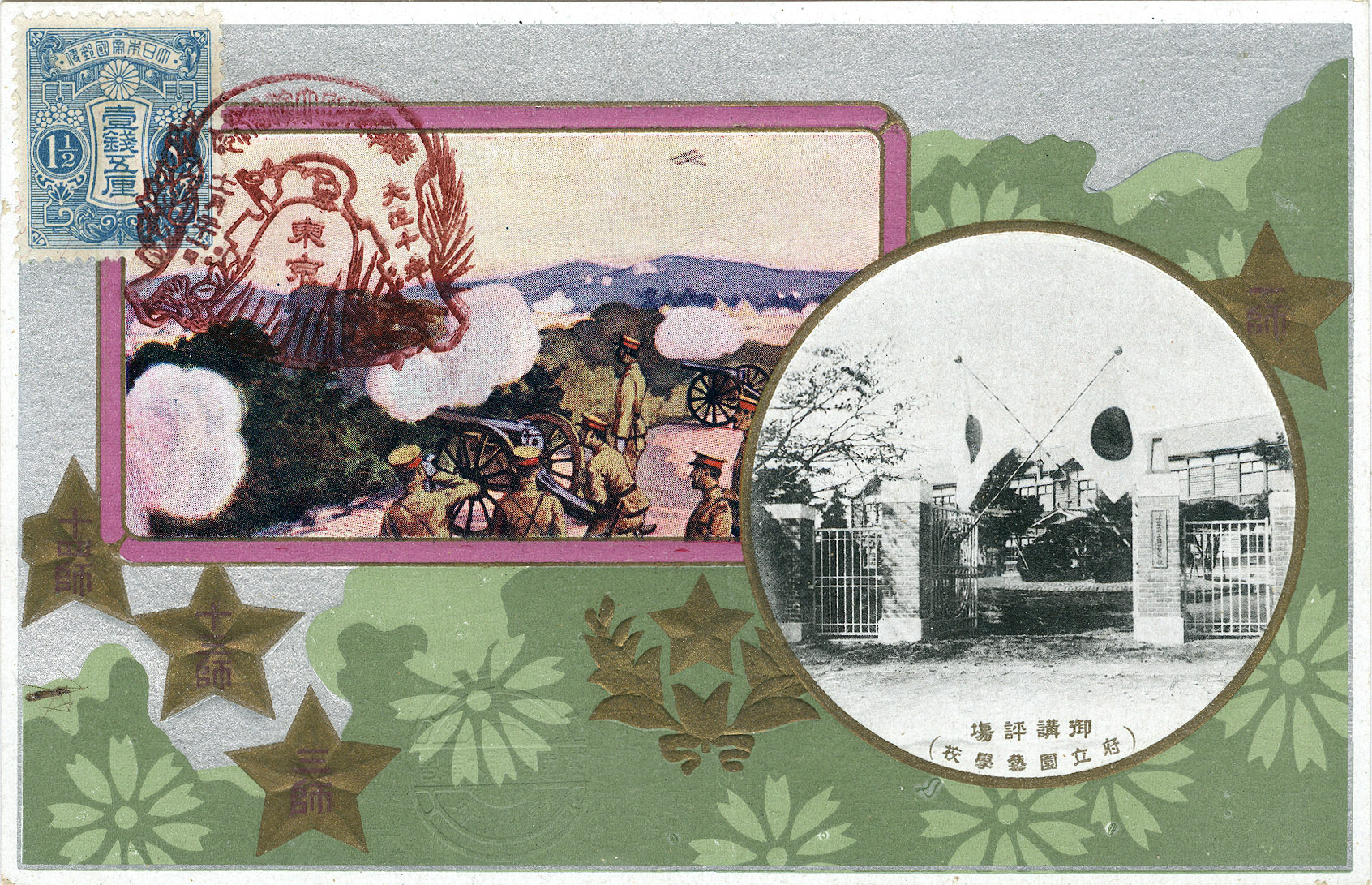
“Commemorative Postcards of the Imperial Army Special Grand Maneuvers”, Kanto Plain, 1921. Pictured at left is an Imperial Japanese Army field artillery live-fire during a battlefield simulation aided by target observers in a spotter plane. At right is the draped gate of the Tokyo Prefectural Horticultural School, Setagaya, where the Crown Prince Hirohito delivered his debriefing. He attended the Special Grand Maneuvers on behalf of his ailing father, the Emperor Taisho, just weeks after his own return from a extended tour of Europe (the first Japanese monarch to travel internationally).
See also:
Special Military Exercises propaganda postcards, Kanto Plain, Tokyo, 1934.
Army Air Defense Drill propaganda postcard set, c. 1930.
Crown Prince Hirohito’s Tour of Europe, 1921.
“Imperial Head-Quarters during the [First] China-Japan War”, Hiroshima, c. 1910.
-

- “Commemorative Postcards of the Special Grand Maneuvers”, 1921. At center is pictured Crown Prince Hirohito (Prince Regent) who acted as proxy for his ailing father, the Emperor Taisho, delivering the Grand Review at the maneuvers’ conclusion. Also pictured is an Imperial Japanese Army infantry platoon in formation-march along a rural road during the exercises.

-
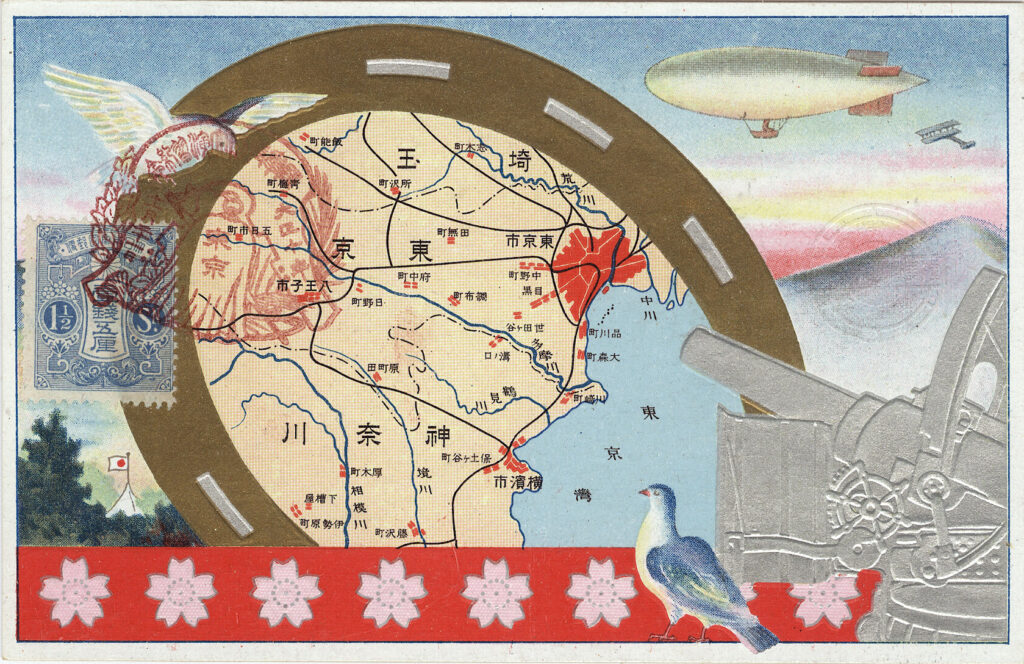
- “Commemorative Postcards of the Special Grand Maneuvers”, 1921. A map depicts Tokyo City in red with various unit deployments across the breadth of the entire Kanto Plain. Pictured at bottom is a carrier pigeon, still an integral battlefield weapon when mobile radio communication was in its infancy, in contrast to observers in the illustrated balloon who could use a radio-telephone line in real-time for communication with stationary artillery coordinators on the ground.

The 1921 Imperial Japanese Army Special Grand Maneuvers (Tokubetsu Dai-Enshū) were held in mid-November. The simulated defensive maneuvers spanned the entire Kanto Plain including modern-day Tokyo, Saitama, and Kanagawa Prefectures, culminating in a major overnight “battle” November 19-20 across the Tama River south of Tokyo City.
A Special Army or Navy Grand Maneuver was always conducted in the presence of the Emperor who would observe forces in formation, tactical maneuverings, and logistics operations, and who would provide a final Grand Review (critique) upon the Special Grand Maneuvers’ conclusion.
Cover: “Commemorative Postcards of the Special Army Grand Maneuvers”, November 1921.
On behalf of his ailing father, the Emperor Taisho, the soon-to-be-named Prince Regent Hirohito attended the 1921 Special Grand Maneuvers, observing a schedule of war-gaming exercises before delivering his final review and debriefing at a temporary GHQ established that year at the Tokyo Prefectural Horticultural School in suburban Setagaya (now site of the Tokyo Metropolitan Engei High School).
The 1922 Special Grand Maneuvers mustered an East Army commanded by General Ōi Shigemoto who was a divisional commander during the recent Siberian Intervention. It featured elite units including the Guards Division, the 1st Division, and aviation units equipped with French SPAD, Salmson, and Farman aircraft. The West Army was commanded by Prince Nashimoto Morimasa, and fielded the 3rd, 13th, and 14th Divisions, backed by Nieuport and Caudron aircraft.
Following the Grand Review in Setagaya Ward, a formal muster was staged at the Yoyogi Parade Ground near suburban Shinjuku featuring the nascent Army Aviation Corps in an official flyover in acknowledgement of its growing importance to ground combat support only 10 years after Japan’s first heavier-than-air flight.
