

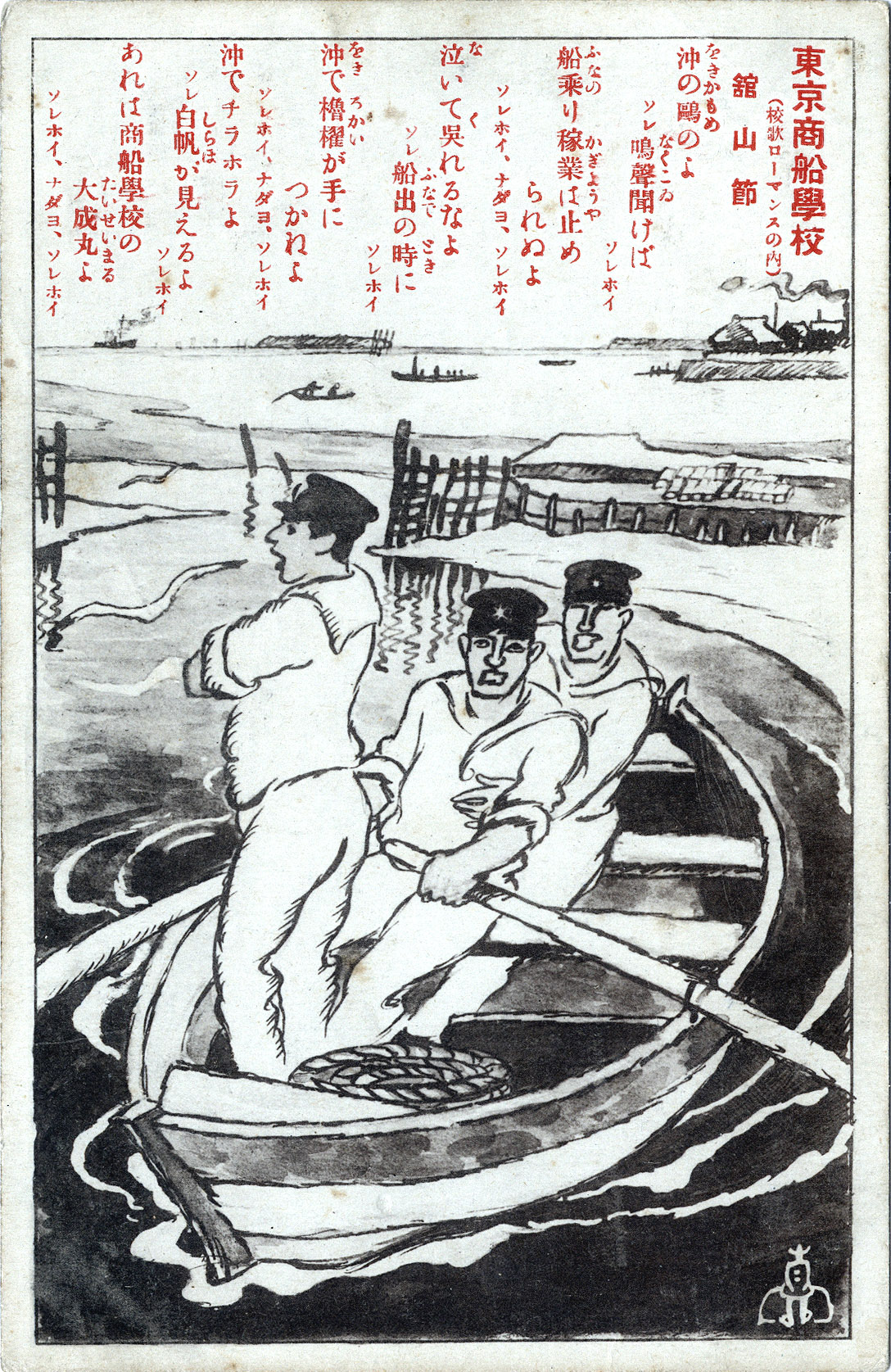
“Tateyama Bushi”, Tokyo Nautical School, Tokyo, c. 1905, features the lyrics to a student song based on a traditional Japanese ozashiki that was adapted into a spirited “sea shanty” at the Tokyo Nautical School song celebrating student life, rowing practice, and their famous training ship, Taisei Maru. The illustration depicts naval/nautical cadets in traditional uniforms and caps straining at the oars of a heavy cutter boat during rowing practice. Behind them, steamships and maritime scenery set the atmosphere of rigorous practical training.
See also:
The Tokyo Nautical School training ship “Taisei Maru”, 1906.
I.J.N. training cruise to the Mediterranean Sea, 1926-1927.
Don’t cry for me when we set sail,
At the moment of departure— (Sore hoi)
Out on the open sea, pulling the oars won’t tire out my hands!
(Sore hoi, nadayo, sore hoi)
– “Tateyama Bushi” third stanza
During the Meiji and Taisho eras, Japanese higher-education institutions (esp. military, naval, and technical academies) cultivated distinct subculture of “school romances” (gakkō rōmansu), similar to a sea shanty or university sporting “fight” song.
The songs were composed of spirited, sentimental, and adventurous lyrics that romanticized the hardships of rigorous physical training, sea voyages, and camaraderie among young cadets.
Mentioned in the final verse, the Taisei-maru was the legendary training ship of the Tokyo Higher Nautical School launched in 1904. It served as an iconic symbol of pride for generations of Japanese merchant marine cadets until its tragic loss during the Pacific War.