

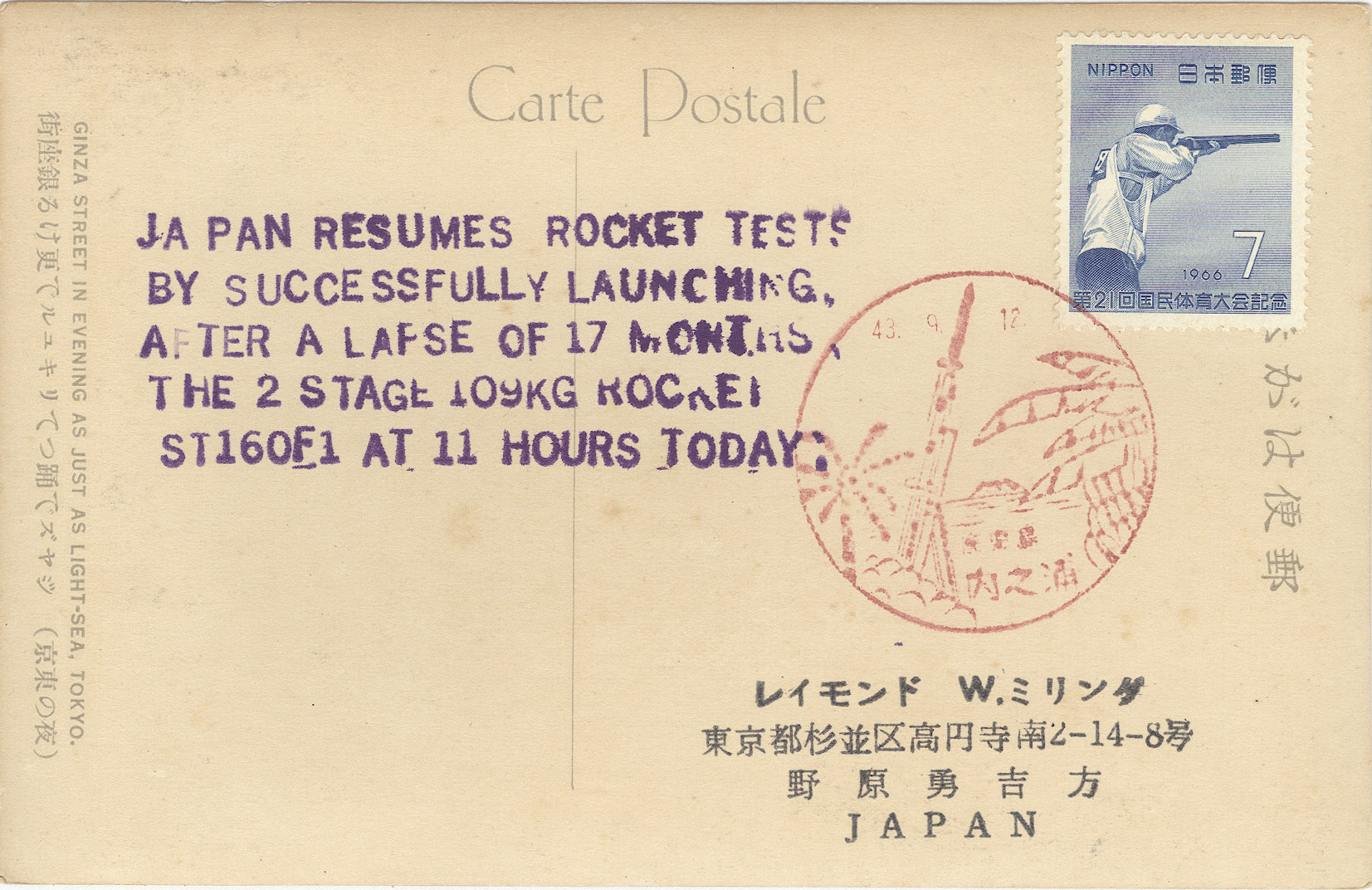
Rocket launch commemorative postcard, Uchinoura Space Center, Kagoshima Prefecture, 1968. Originally named the Kagoshima Space Center when established in 1962, the site was chosen for its remote coastal location facing open ocean to safely accommodate eastward rocket trajectories. The red stamp is a special commemorative postmark (September 12, 1968) designed specifically for mail sent on launch days, illustrated by a rocket lift-off past the local palm trees. (A Suginami Ward resident submitted a self-addressed stamped vintage postcard of Tokyo’s Ginza on the reverse to be postmarked upon launch.)
In the first half-decade of the 1960s, Japan’s emerging space program faced greater public scrutiny and investigations following a series of Lambda rocket failures. Testing was suspended for roughly 17 months so Japan’s new space agency — the Institute of Space and Aeronautical Science (ISAS) — could provide new engineering and safety protocols.
The large purple stamped text captured the moment the hiatus ended: “JAPAN RESUMES ROCKET TESTS BY SUCCESSFULLY LAUNCHING, AFTER A LAPSE OF 17 MONTHS, THE 2 STAGE 109KG ROCKET ST160F1 AT 11 HOURS TODAY” from Japan’s Uchinoura Space Center on the Ōsumi Peninsula in Kagoshima Prefecture.
Years prior, in the 1940s, both the Imperial Japanese Army and Navy built solid-propellant artillery rockets for battlefield use while also successfully testing liquid-propellant technologies, e.g., the I.J.N.’s Yokosuka MXY7 Ohka piloted kamikaze missile.
In the years immediately following the war, Allied Occupation forces strictly prohibited Japan from conducting any aeronautical or missile research. The ban was lifted only after the San Francisco Peace Treaty was promulgated in 1952, formally ending the war and the Occupation.
Two years later, Professor Hideo Itokawa—a former WWII aircraft designer with Nakajima Aircraft Co.—assembled Japan’s first space research team, the Avionics and Supersonic Aerodynamics (AVSA) Group at the University of Tokyo. On April 12, 1955, AVSA began test firings of a tiny projectile known as the “Pencil Rocket.” Though measuring just 9 inches in length, 200 grams in weight, and used for horizontal engine testing, the Pencil Rocket is generally regarded as the genesis of Japan’s modern space effort.
Retiring in 1967, Itokawa is known today as “Dr. Rocket” or the father of Japanese rocketry. Beyond creating Japan’s first rocket, he orchestrated a consolidation of his AVSA with two other government-funded avionics programs to establish the Institute of Space and Aeronautical Science (ISAS) in 1964. This occurred during a time of intense public scrutiny after a series of Lambda rocket launch failures.
The September 1968 maiden flight of the S-series 109kg ST-160F rocket, commemorated by the postcard above, signaled that Japan was officially back in the space race. Two years later, Japan launched its first orbital satellite, Ohsumi, aboard a Lambda 4S rocket on February 11, 1970. This made Japan the fourth nation in the world, following the USSR, the USA, and France, to place an indigenous satellite into Earth orbit.