

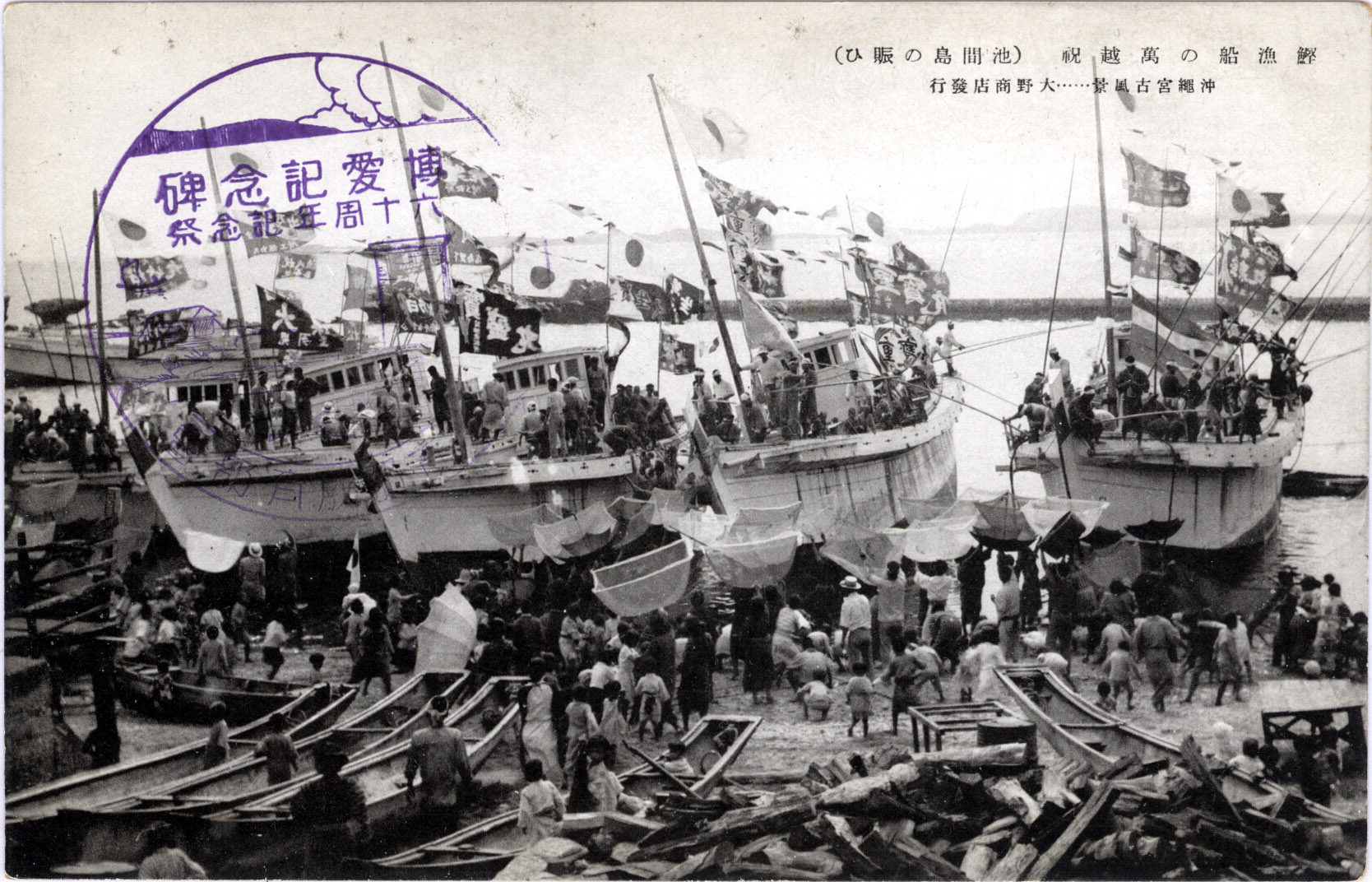
“Celebration of a Bumper Catch for Skipjack Tuna Fishing Boats (Bustle of Ikema Island)”, Ikemajima, Miyako-gun, Okinawa, 1936. Ikemajima is a small island off the northern tip of Miyakojima in Okinawa Prefecture, and has historically been one of Japan’s most famous fishing grounds for skipjack tuna (katsuo). The celebration (mankoshi-iwai) refers to the traditional festivities held whenever a fishing boat reaches a milestone catch (typically 10,000 fish). The postmark commemorates the 60th anniversary of islanders rescuing sailors from a German merchant ship run aground during an 1876 typhoon.
See also:
“A fishing place in Awaji”, Hyogo Prefecture, c. 1920.
Dried octopus, Amakusa, Kumamoto Prefecture, c. 1960.
Ikemajima fishermen are docked, their vessels decked out in celebratory flags including traditional Tairyō-bata [big catch flags]. The area was known as one of Japan’s most famous fishing grounds for skipjack tuna. Beached on the shore and alongside the bigger boats are traditional Okinawan wooden sabani, dugout canoes used historically for reef fish and shark hunting in local waters. The postmark commemorates the 60th anniversary of islanders rescuing sailors from a German merchant ship run aground during an 1876 typhoon.
In 1873, a German merchant ship, the R.J. Robertson, ran aground off Miyakojima during a typhoon. The islanders braved harsh weather to rescue the crew, nursed them back to health, and arranged their safe return. Deeply moved by this act of international goodwill, German Emperor Wilhelm I sent a grand monument to the island in 1876, known as the German Emperor’s Philanthropy Monument (Doitsu Kōtei Hakuai Kinenhi). Translated to English, the monument is inscribed:
In July 1873, the German ship *R. J. Robertson*, commanded by Captain Hernsheim of Hamburg, ran aground on the rocks off the coast of Typinsan. The crew was rescued with the help of the local inhabitants, brought to safety, and hospitably cared for for 31 days until their return journey could be arranged on August 17, 1873. In grateful recognition of this praiseworthy conduct, We, Wilhelm—by the Grace of God, German Emperor and King of Prussia—have ordered the erection of this monument to serve as an enduring memorial.
Sixty years later, Miyakojima hosted a massive three-day island-wide festival from November 13–15, 1936, attended by local leaders, Japanese government officials, and German diplomats, and a second monument was placed near the site of the wreck reading “Site of the German Merchant Shipwreck”.
Postcards printed locally by merchants like Ōno Store (publisher of this postcard) were stamped with the purple commemorative seal to mark the occasion.