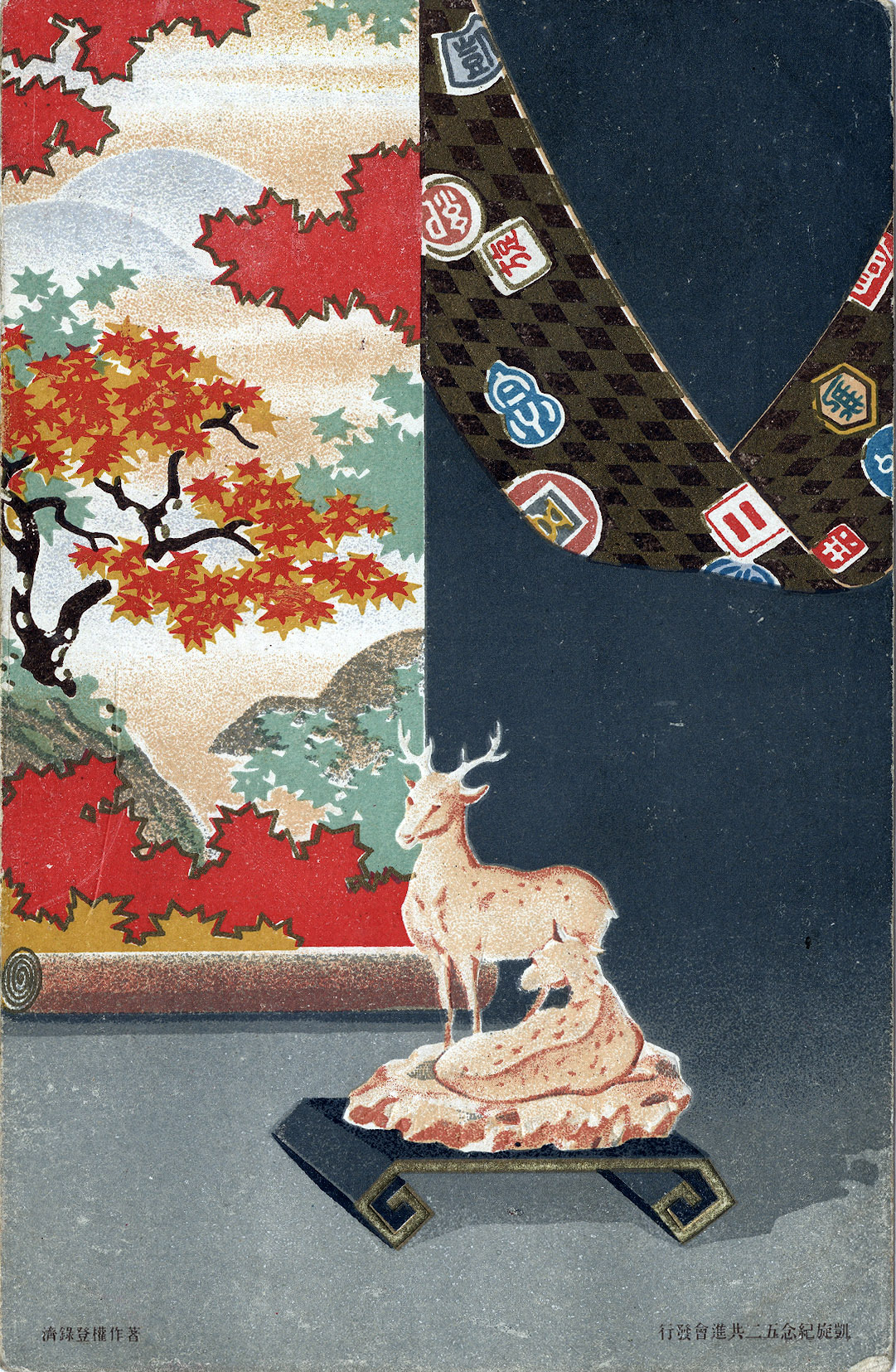


Goni-Fair Exhibition Association promotional postcard, Nihonbashi, Tokyo, 1906. The flagship Mitsukoshi department store at Nihonbashi served as a primary commercial partner and venue for a retail exhibition held commemorating Japan’s victory the year before in the Russo-Japanese War (1904-1905).
See also:
“Imperial Princesses Making Bandages”, Russo-Japanese War, c. 1904.
Russo-Japanese War (1904-1905).
Mitsukoshi Gofukuten advertising postcards, c. 1905.
The Goni-Fair (Gaisen Kinen Go-Ni Kyōshinkai) was a major trade, industrial, and cultural exhibition held in Tokyo from September to December 1906 (Meiji 39).
“Commemorating [the] Empress’ Visit”, Goni-Fair, Mitsukoshi department store, 1906. Empress Shōken (consort of Emperor Meiji) paid a personal visit to the Go-Ni Fair at Mitsukoshi on October 18, 1906. The illustration showcases luxurious woven textiles and rolls of fine kimono fabric -— a direct reference to the high-end textile trades represented by the 52 Guilds and displayed at Mitsukoshi.
The Go-Ni Kai (五二会, 52 Guilds) organized the fair to celebrate Japan’s victory in the Russo-Japanese War (1904–1905) and the safe return of Japanese troops. The marketing group was composed primarily of an influential industrial trade organization first formed in 1894 (Meiji 27). The group derived its name from the 52 trade and craft guilds original to its formation.
Goni-Fair was a months-long celebration taking the form of a kyōshinkai, a competitive exhibition. Artisans, manufacturers, and trade guilds from across Japan and its territories were invited to submit product samples ranging from textiles, ceramics, and artificial flowers to musical instruments and modern prints for judging and prestigious awards.
When the Meiji government abolished the old feudal guild systems (kabunakama) in the 1870s, it created an unforeseen side effect: an influx of unregulated, low-quality, and counterfeit traditional goods which harmed the reputation of Japanese traditional arts both at home and in lucrative Western export markets.
In reaction, Go-Ni Kai were among the trade groups subsequently formed to enforce quality control and standardization across regional workshops. Groups formed also promoted innovation (e.g., integrating Western art styles like Art Nouveau with classical Japanese techniques) and to provide national marketing and distribution channels for local artisans.
“Published in commemoration of the Triumph”, Goni-Fair, Mitsukoshi Department Store advertising postcard, 1906.
The flagship Mitsukoshi department store at Nihonbashi served as the event’s primary commercial partner and venue, accommodating the product exhibitions with its own displays of high-end luxury crafts, modern kimonos and textiles, and imported lifestyle sundries.
Go-Ni Kai was also instrumental in the development of Japanese tourism. In 1899, the association opened the Go-Ni Kai Hotel in Ise (Mie Prefecture) to accommodate foreign dignitaries and high-profile visitors touring regional industries.