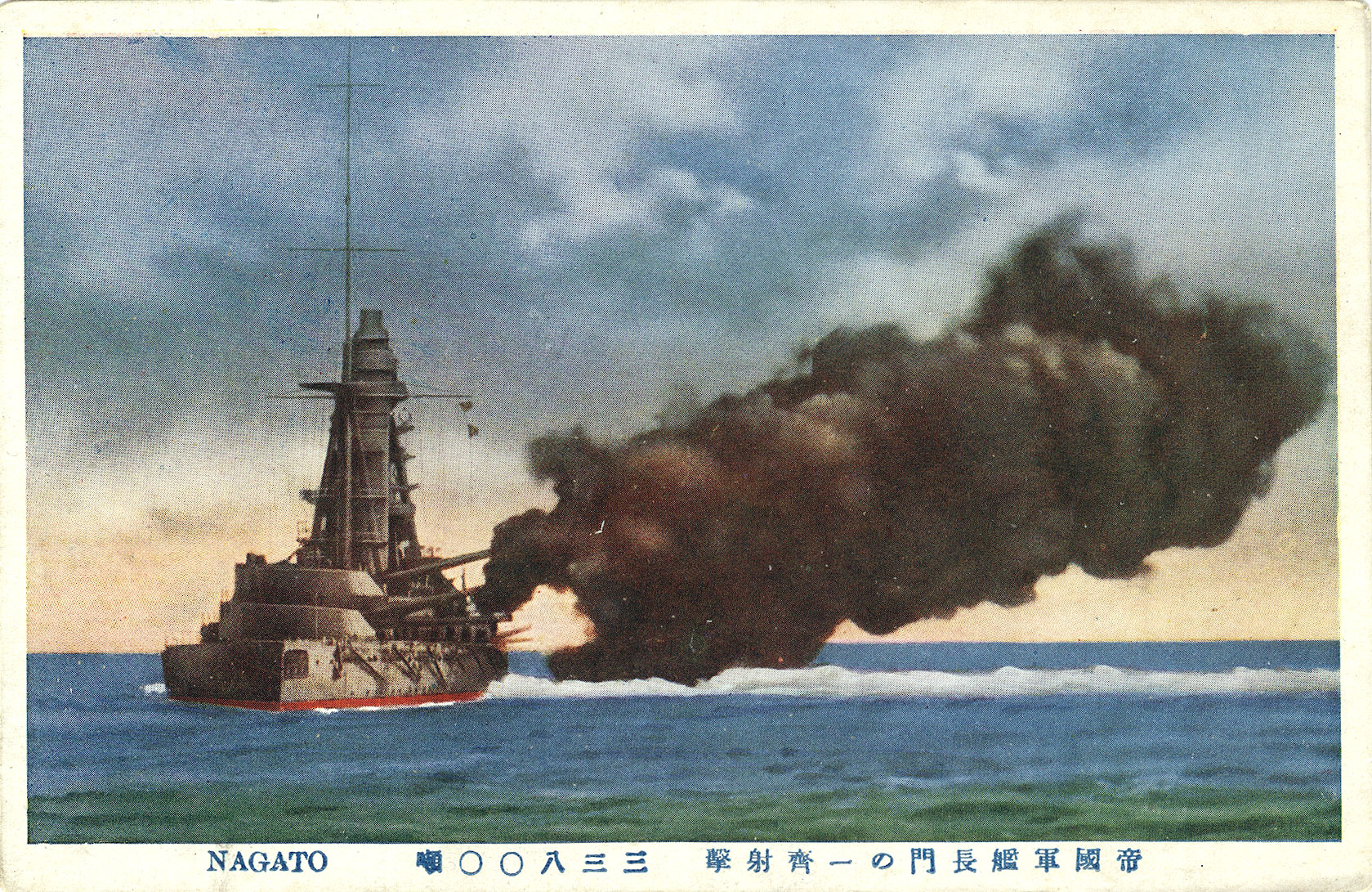

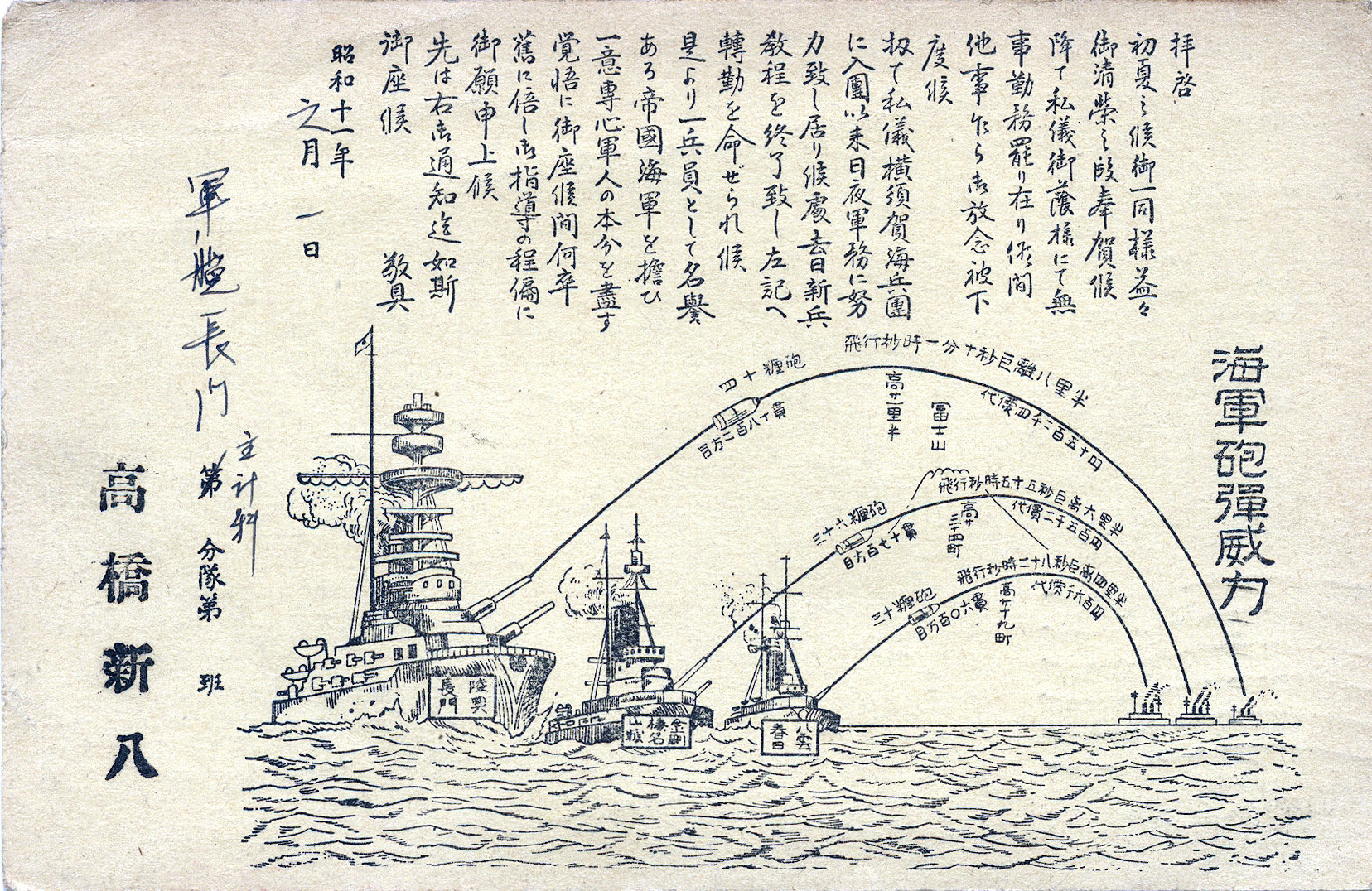
“The Power of Naval Gunfire”, Imperial Japanese Navy propaganda postcard, 1935. Depicted left to right are three historic capital ships – the newly-commissioned battleship Nagato (1924), the battleship Yamashiro (1914), and the cruiser Kasuga (1904) – indicating the ranging differences between their respective main armaments as weapons technologies advanced in the early 20th century. Each is depicted hitting or clearing an inland target, from Yoyogi Parade Ground in Tokyo City 10-miles away to Mt. Takao in the Japan Alps foothills more than 30-miles away – a shot that would also clear Mt. Fuji’s 12,000+-foot summit.
“In this early summer season, I am pleased to hear of your continued good health. I am well and diligently performing my duties, so please do not worry about me. With deep loyalty, I strive to fulfill my duties as a member of the Imperial Navy, praying for the prosperity and strength of our Empire’s sea forces.”
– Postcard caption
See also:
Imperial Japanese Navy Battleship “Nagato”, c. 1925.
“‘Eight-Eight’ Fleet Program”, Imperial Japanese Navy, c. 1925.
Naval Battles of Miyako Bay and Hakodate (May 1869), Boshin War commemorative postcards, c. 1930.
During Japan’s 50-year sprint toward modernization, the Imperial Navy’s naval armament technology rapidly advanced from mixed-caliber, short-range punch (Kasuga) to world-leading super-dreadnought 16-inch gunnery supremacy (Nagato) as the I.J.N. evolved from a coastal defense force into a formidable transoceanic naval power.
Kasuga and its sister ship, Nisshin, were pre-dreadnought Italian-built Giuseppe Garibaldi-class cruisers originally ordered by Argentina. But the lessening of tensions with Chile and associated financial pressures caused the Argentinians to sell the two cruisers before delivery. Argentina offered the pair to both Japan and Russia. Russia could not meet the asking price and Kasuga and
Nisshin wound up being sold to Japan in 1904 on the eve of the Russo-Japanese War. (Neither warship played any dramatic role in the ensuing conflict.) With its “mixed-caliber” armament arrangement, principally its 1 x 10-inch (254 mm) forward turret, Kasuga offshore in Tokyo Bay could hit a target with a 1000 lb. shell in the Yoyogi suburbs of Tokyo City 10-miles away.
Dreadnought Yamashiro was the second of two Fuso-class battleships launched on the eve of World War I in 1912. It represented a great leap in ship-borne firepower, with 6 × 14-inch (356 mm) turreted guns that could hit multiple targets 15-miles away. The total firepower of Yamashiro represented a 1400% increase over the mixed-caliber firepower of Kasuga.
The Nagato-class battleships, constructed between 1917-1921, represented the first of the world’s true super-dreadnoughts to arrive between the world wars. Nagato was the first battleship launched in the world armed with 16-inch guns firing 18,000 lb. shells, with a 20-mile range — double that of Kasuga — beating the launch of the U.S. Navy’s Colorado super-dreadnought class by a narrow margin — marking the I.J.N.’s arrival on the world scene as a first-rate global naval.
-
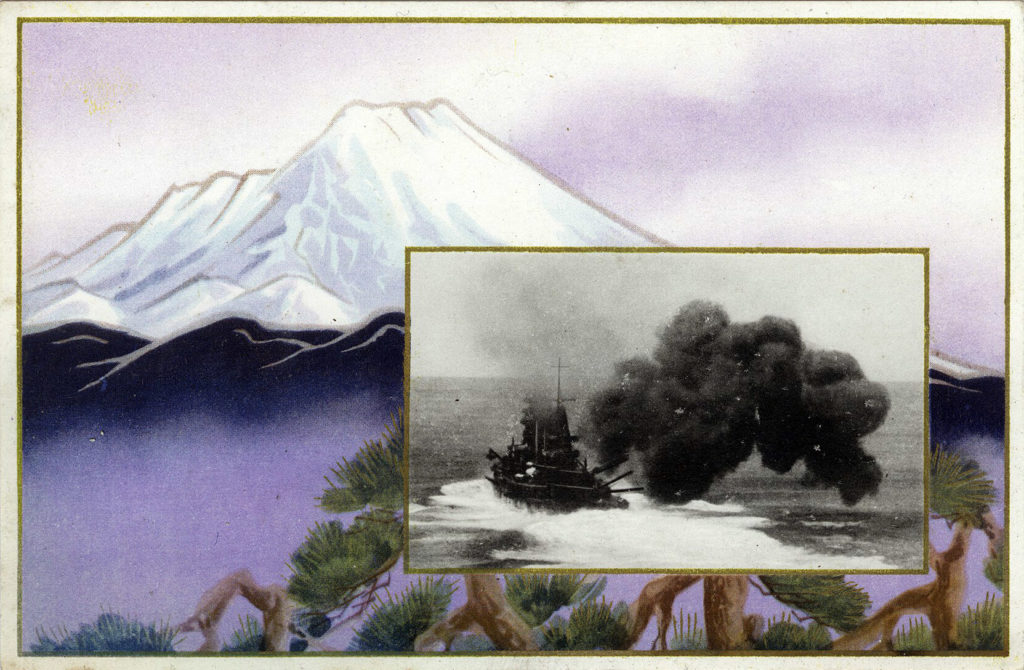
- Battleship Nagato firing its big guns broadside in practice, c. 1925.
-
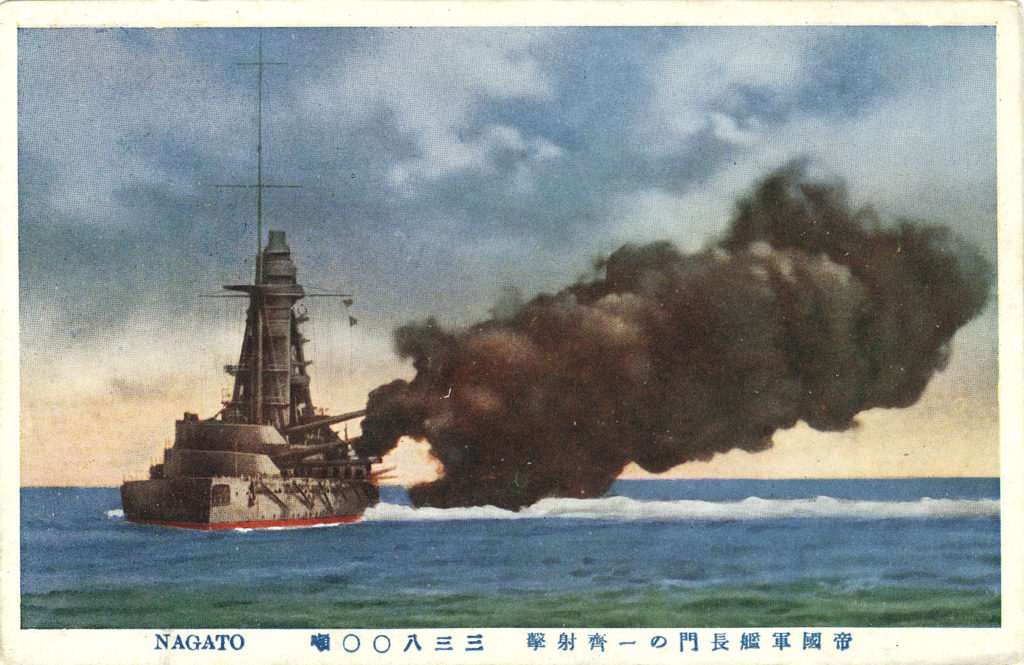
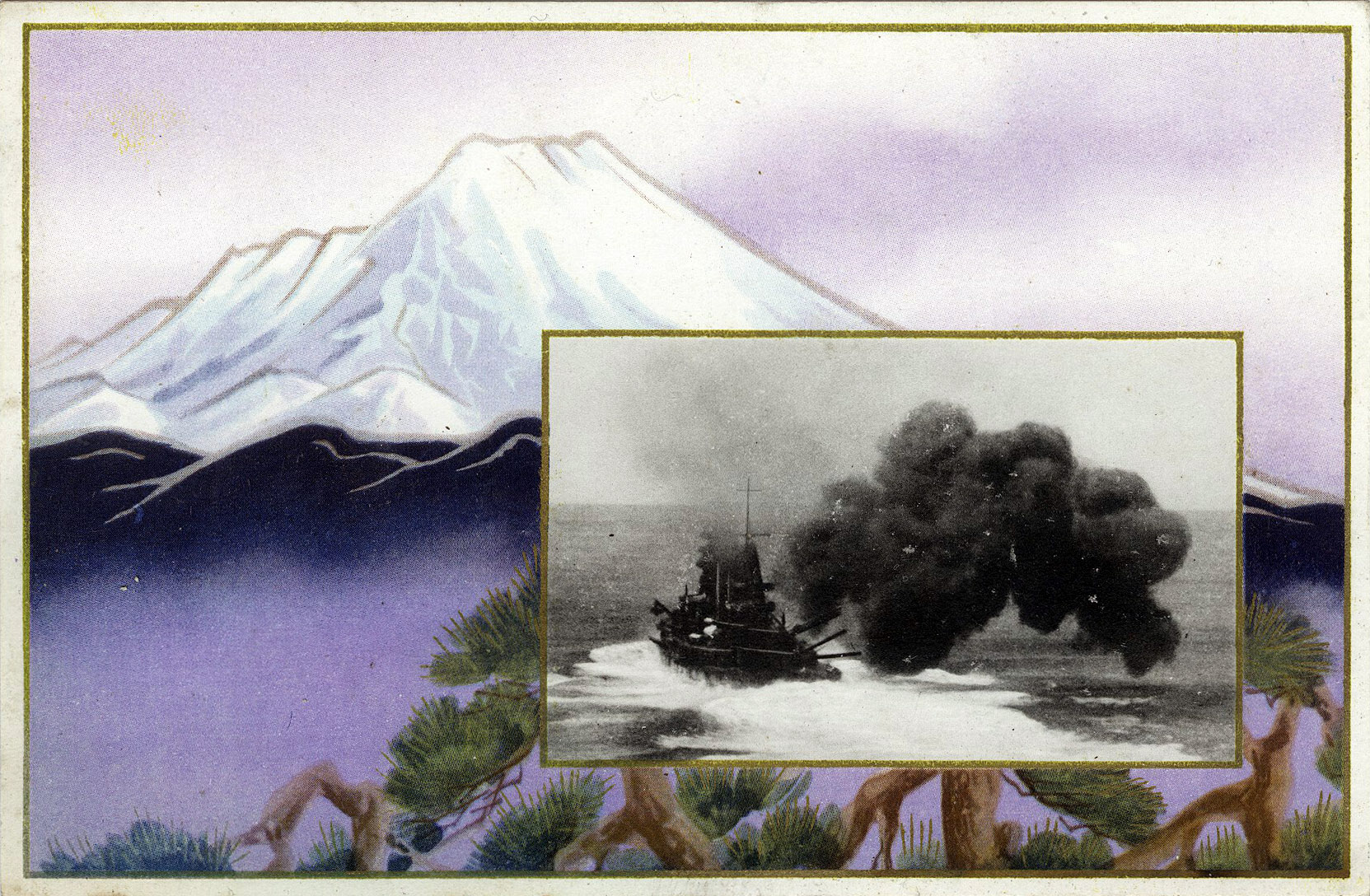
- Battleship Nagato firing its big guns broadside in practice, c. 1925.