

– In Praise of Shadows, Tanizaki Jun’ichirō, 1933
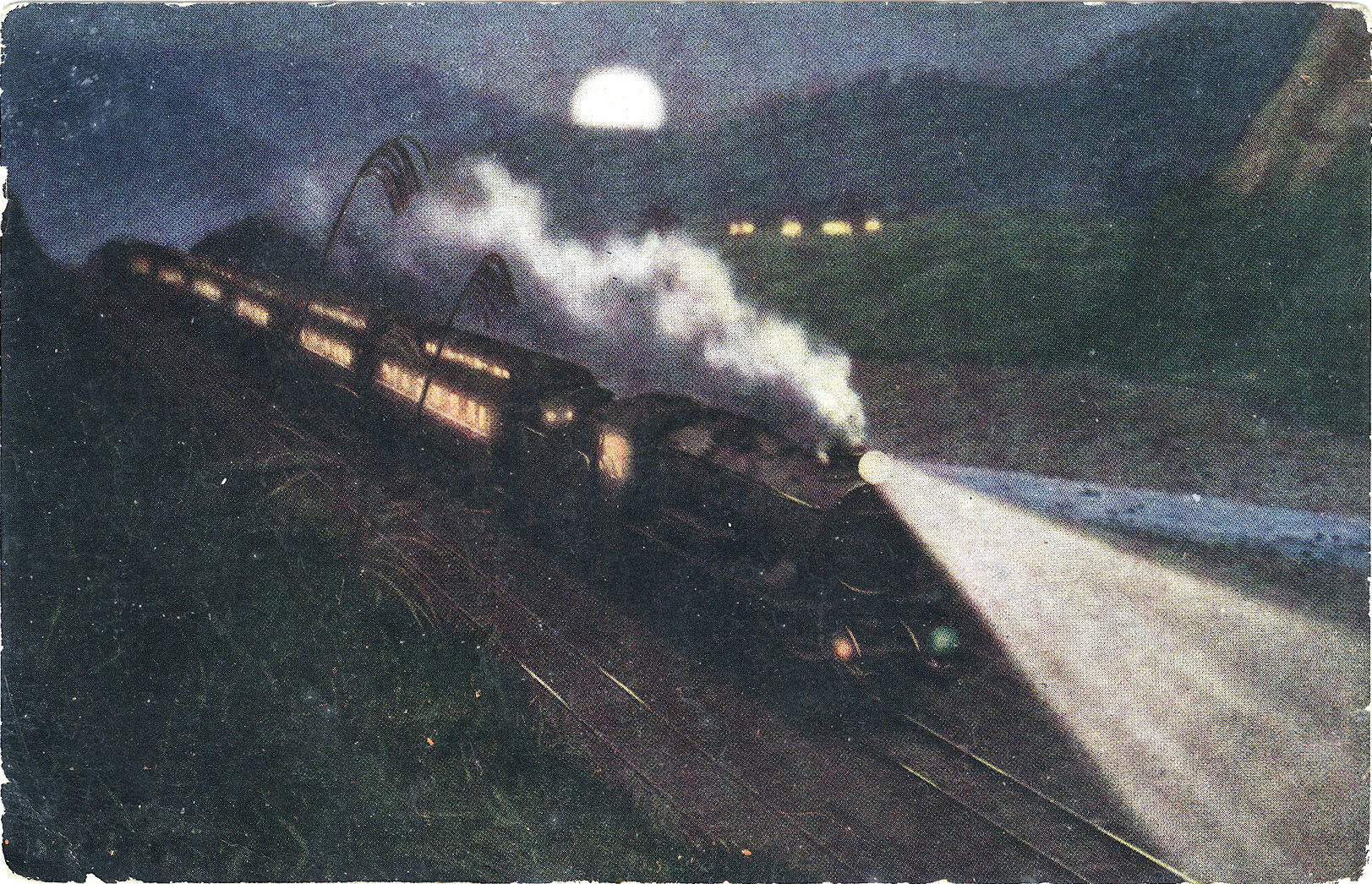
JGR Tokaido Main Line night train and autumn moonlight, c. 1920. In the distance are a hillside village’s evening lights. Waving beside the track, lit by an autumn moon, are susuki (Japanese pampas grass) with feathery tassels that reach full height in the cooler weather of September and October. The locomotive pulling the express train is likely a Class 8620, Japan’s first domestically-designed and manufactured passenger steam locomotive, built in large numbers between 1914 to 1929 before being retired in 1975.
See also
J.G.R./J.N.R. Steam Locomotive Evolution, 1872-1948.
8620-class steam locomotive, c. 1960 reprint.
C55 Streamlined Locomotive and Mt. Fuji, c. 1940.
The Class 8620 steam locomotive (affectionately known as the “Hachi-Roku”) was introduced into service beginning in 1914. It was Japan’s first domestically designed and mass-produced passenger steam locomotive.
Before the introduction of the 8620, Japanese Government Railways (JGR) had relied almost entirely on imported locomotives from Germany, Great Britain, and the United States. The 8620 proved that domestic builders like Kawasaki Heavy Industries and Nippon Sharyo could produce world-class superheated locomotives tuned specifically for operations on Japan’s narrow-gauge track.
A total of 672 locomotive units were built between 1914-1929, making it the face of express passenger rail service during the post-WWI Taisho era. The last of the class was retired from switchyard service in 1975. JR Kyushu restored one 8620 locomotive in the mid-1980s and returned it to service in 1988 as a nostalgic excursion train engine until sending it back into a second retirement in 2024 where it is kept in operational condition to run on a short museum demonstration track.
Susuki — Japanese pampas grass — is the primary plant symbol of Tsukimi, the autumn moon-viewing festival. Taisho era illustrators were apt to combine evocative indigenous imagery (e.g., susuki lit by the moon) with modern industrial symbols (e.g., express trains) to create a union of the past with the present.