

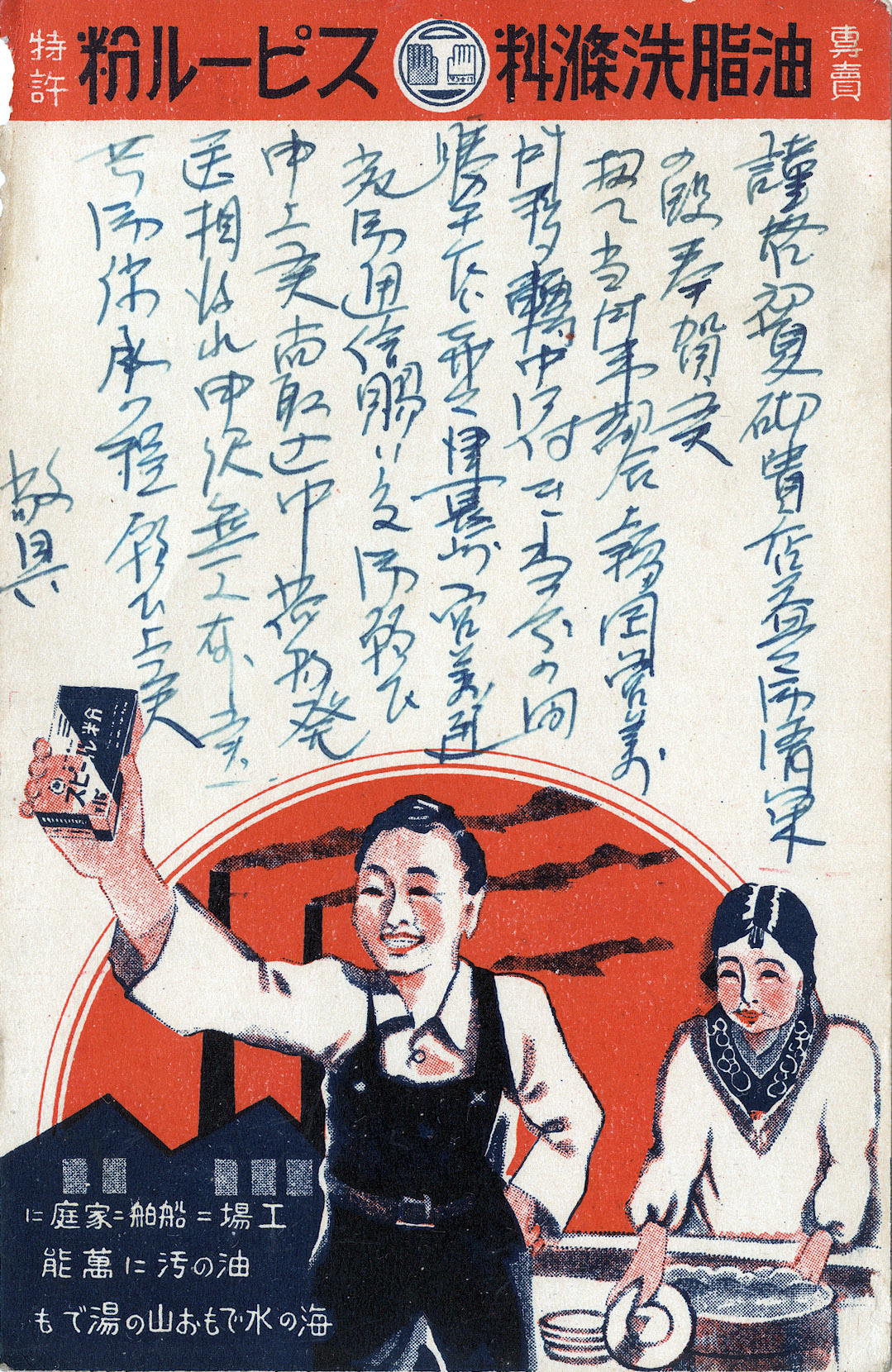
“Exclusive sale – SPIEL Powder” cleanser advertising postcard, c. 1930. Captioned lower-left: “For households – ships – factories. All-purpose. Use with seawater or mountain hot spring water alike.”
“Honored customers, Spiel Powder is an effective and easy way to wash away all dirt and oil.
It works wonderfully in households, on ships, and in factories.
Removes stubborn grease with ease, leaving everything sparkling clean.
We are pleased to recommend it with confidence.”
See also:
“Club Washing Powder” advertising postcards, c. 1910.
“Modern Shampoo” advertising postcard, c. 1935.
With the advent of the Meiji Restoration (1868), Japan began to rapidly import Western technologies, consumer goods, and domestic habits, including hygiene and sanitation practices. Soap powders were among the Western innovations Japan imported.
Prior to modernization, rice bran was the most common household cleanser. Tied into small cloth bags or ground into a paste, it was used for washing hands, face, and dishes. Other common feudal cleansers included wood ash, where the alkali in ash worked as a primitive soap. The juice from mukoroji [soapberry tree] fruit was used for cleansing hair and delicate fabrics.
Bar soaps of mostly British or American origin began appearing in the treaty ports beginning in the 1860s–70s. Then, beginning around 1873–1875, Japan’s first modern soap factories appeared in Tokyo and Osaka. One of the earliest large-scale producers, Kao, used imported fats and caustic soda for the manufacture of its soaps.
In the 1930, the first synthetic detergents (e.g., Dreft or Persil) that were made from sulfonated hydrocarbons or alcohol sulfates rather than natural fats, began to be imported into Japan from Europe and the United States. A few Japanese chemical companies, including Kao, experimented with small-scale domestic soap synthesis, but full production was limited by the Pacific War.