

“Mr. Rikichi Okada is the owner of the Aizuya Honten and has long been known as maker of lacquerware.
“It was in April, 1887 that he opened his store at the present locality [in Nihonbashi] and since then his business has steadily grown in prosperity.
“Formerly, Mr. Okada was engaged in [both] the manufacture and export of lacquerware, but has confined himself now only to the sale of the wares.”
– Rising Japan: Commemorating the Enthronement Ceremony of H.I.H. the Emperor of Japan, Jidai Kenkyu Kai [Period Research Institute], 1918
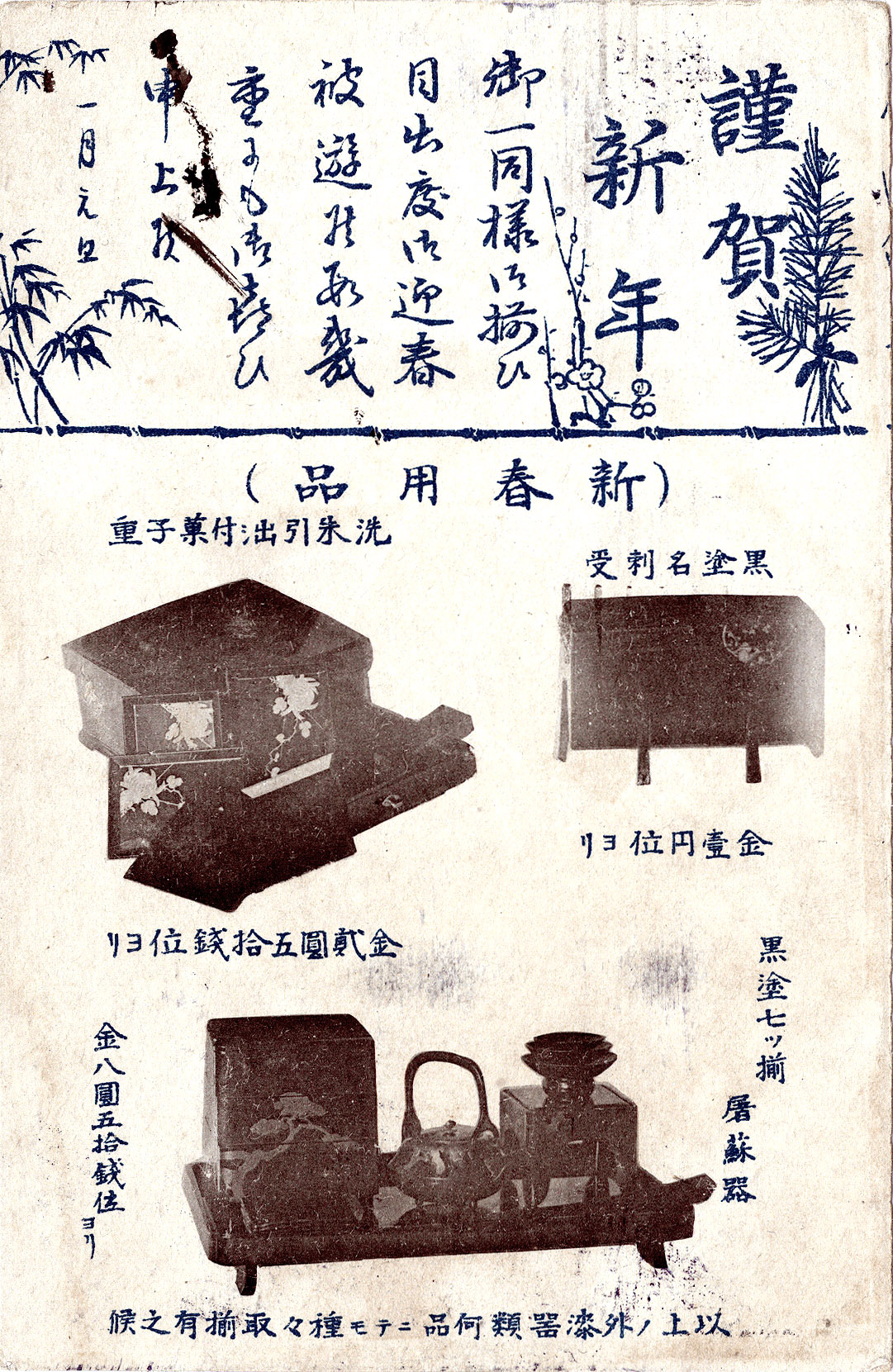
“New Year’s Supplies of the Imperial Fifth-Rank Style”. Aizuya Honten Lacquerware Wholesaler, New Year’s advertising postcard, Nihonbashi, Tokyo, c. 1905. Early use of collotype for photo reproductions. Among the items displayed are (clockwise from top-left) a lacquered confectionary case, lacquered presentation tray (for calling cards), and a black-lacquered seven-piece tea set.
See also:
Rug and carpet factory, c. 1920.
It has been confirmed that the lacquer tree (Toxicodendron vernicifluum existed in Japan from 12,600 years ago in Japan during the Jōmon period, and it is believed that lacquering was developed in the same period. The oldest lacquerware in the world to have been found are burial ornaments dating to ca. 900 B.C.E., uncovered near Hakodate, Hokkaido.
The Jōmon learned to refine urushi (poison oak sap) – the processing taking several months. Iron oxide (colcothar) and cinnabar (mercury sulfide) were used for producing red lacquer used both on pottery and on different types of wooden items. The Edo period (1603–1868) saw an increase in the focused cultivation of lacquer trees and in the development of the maki-e (lit. “sprinkling pictures”) techniques used which set Japanese lacquerware apart from others.
The artistic quality of lacquerware improved as embellishments were further refined. From the middle of the Edo period, inro (miniature case) became a popular men’s accessory. Wealthy merchants and samurai collected inro of high aesthetic value, precisely designed with lacquer.
After the Restoration, the Meiji government took an active interest in the art export market, promoting Japan’s lacquerware and other decorative arts at a succession of world’s fairs.
Outside Japan, Marie Antoinette and Maria Theresa were known collectors of Japanese lacquerware and their collections are still often exhibited in the Louvre and at the Palace of Versailles.