

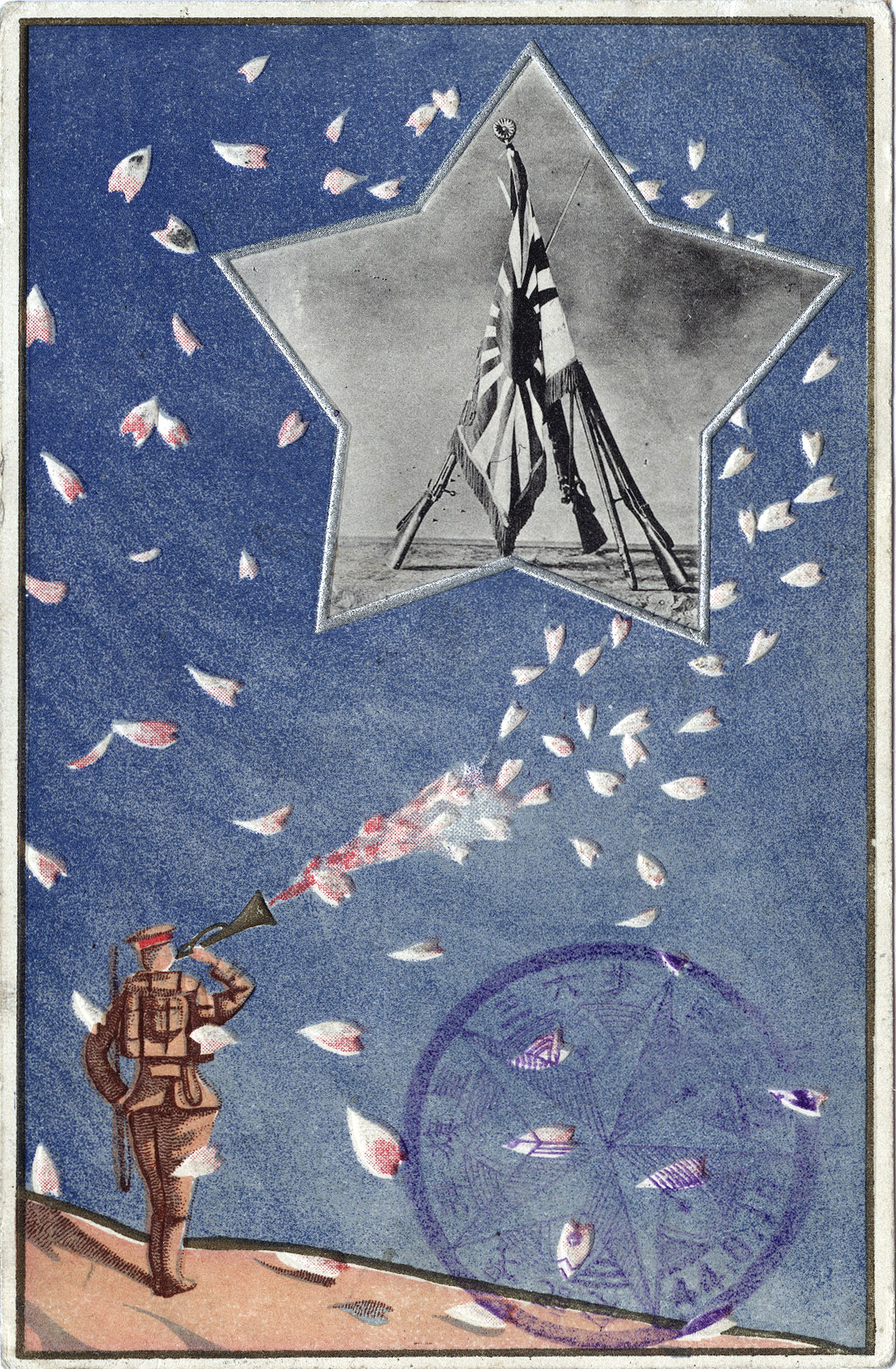
“Special Army Grand Exercise”, 63rd Regiment, 18th Division, Imperial Japanese Army, Kurume, Kyushu, 1911.
Created in 1898 as part of a major post–First Sino-Japanese War army expansion under the 1896 Army Reorganization Law, the 28th Division was garrisoned in Kurume, Kyūshū, as an element of the Western District Army — the command overseeing Kyūshū, where it remained for most of its existence. In August 1911 the 18th Division staged a “Special Army Grand Exercise” in the presence of Emperor Meiji. Such displays were large, highly publicized events — key moments for a garrison to show its readiness and prestige.
In 1914, the 18th Division became the core component of the Japanese Expeditionary Army under General Kamio Mitsuomi, responsible for the Siege of Tsingtao, which lasted from September to November 1914. It was the first encounter between Japanese and German forces in WWI, the first Anglo-Japanese joint operation of the war (under terms of the 1902 Anglo-Japanese Alliance), and the only major land battle in the Asian and Pacific theaters between the Entente and the Central Powers during the whole of World War I. Tsingtao surrendered to the Allies on 16 November 1914 after waves of Japanese infantry overwhelmed German and Austro-Hungarian defenders.
The 18th Division was later deployed from Kurume to China in 1937 after the Marco Polo Bridge Incident, spending several years garrisoned in central and southern China. In January 1942, the 18th Division was transferred to Southeast Asia Command for the invasion of Burma, fighting the battles of Rangoon and Sittang Bridge but suffered catastrophic losses during the Battle of Imphal (March–July 1944). By mid-1945, the division was a literal skeletal force.
After the Emperor’s surrender announcement on 15 August 1945, the division’s survivors surrendered to British and Indian forces in southern Burma. They would be repatriated back to Japan in 1946.