

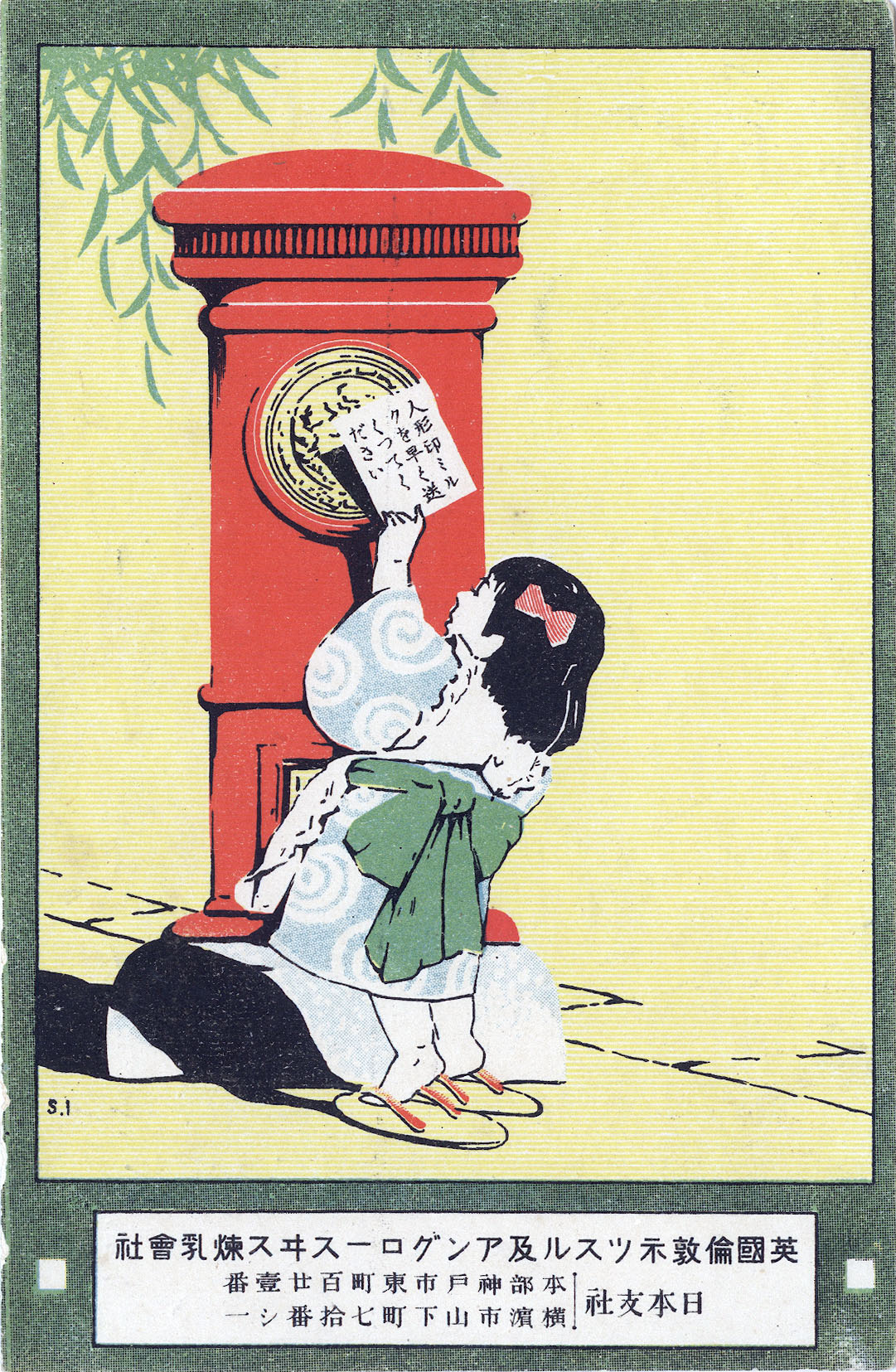
“Please send lots of milk every day to make people strong”, Anglo-Swiss Condensed Milk Company, New Year’s advertising postcard, c. 1905. A child deposits a New Year’s greeting card (nengajō) with its wishful message into the postal collection box.
See also:
Meiji Merry Brand Sweetened Condensed Milk, c. 1930.
Meiji-brand “Cream Caramel” advertising postcard, c. 1935.
Japan Postal Service 50th Anniversary commemorative postcards, 1921.
Over the course of the Meiji period, in a land sparse of dairy cattle and dairy industry, condensed milk became a popular imported food and a symbol of Western-influenced modernization in Japan.
Used to some degree in home cooking and baking, condensed milk in Japan more widely popularized sweetened tea and coffee, and was a particularly significant “new food” responsible for the early development of the Japan’s café and confectionery cultures.
The Anglo-Swiss Condensed Milk Company, founded in 1866, and the Henri Nestlé Company, founded in 1867, merged in 1905 to form the “Nestlé and Anglo-Swiss Milk Company”, retaining that name until 1947. By the 1920s, the company had factories around the world and a London-based export sales office.
In Japan, the act of mailing a New Year’s card (nengajō) is central a deep-rooted tradition. New Year’s is the most important holiday in Japan, and the note being deposited into the postal collection box specifically mentions the importance of the New Year’s postmark that will guarantee the card will be delivered precisely on January 1st. Missing the deadline was considered a social faux pas.