

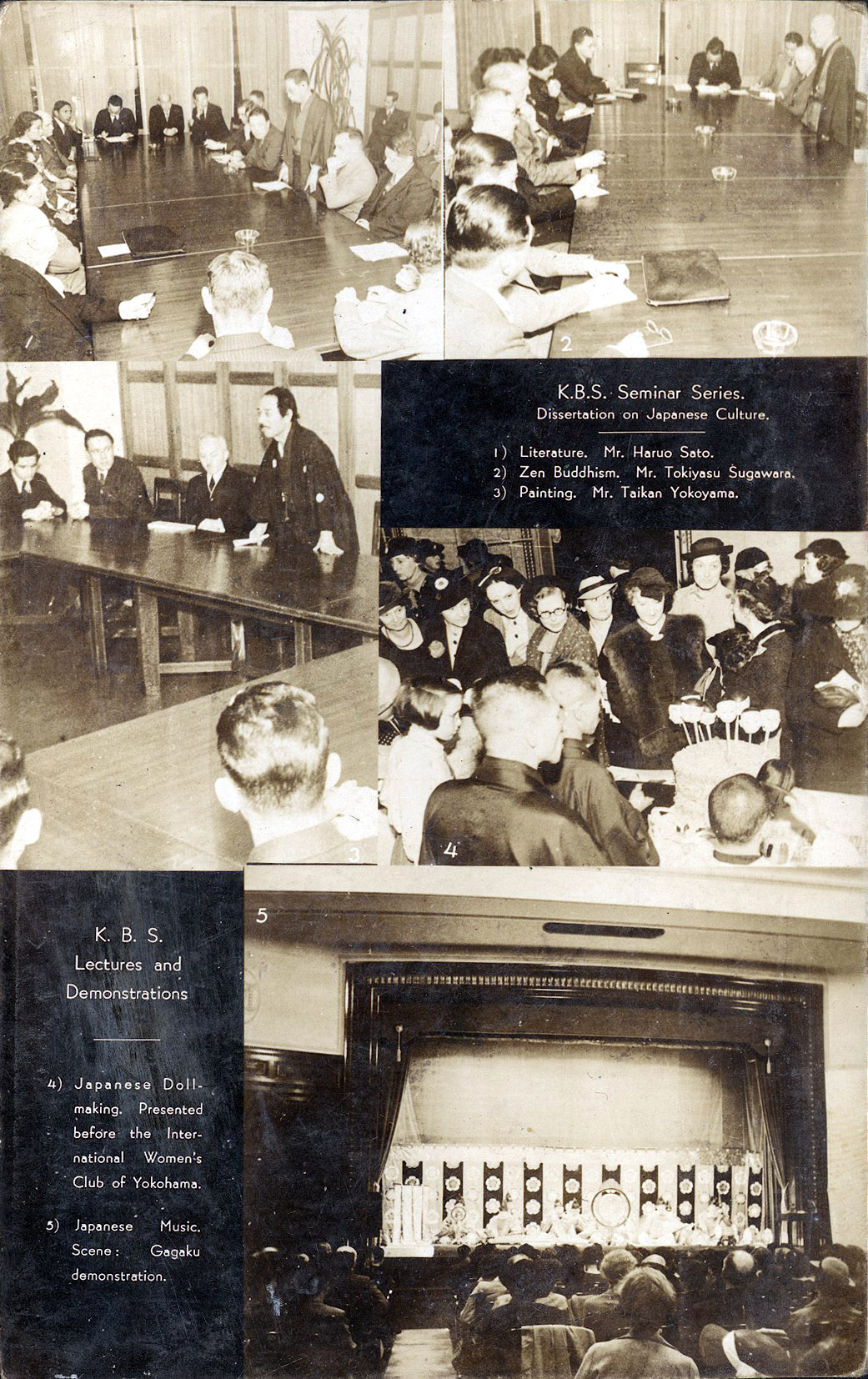
Kokusai Bunka Shinkōkai (K.B.S.) lecture series commemorative postcard, Yokohama, c. 1955. K.B.S. was founded in the early 1930s as an imperialist propaganda outlet but was reorganized after the Pacific War into a cross-cultural non-government organization.
See also:
International House, Azabu, Tokyo, 1968.
Kokusai Bunka Shinkokai (K.B.S.) was founded in 1934 under the auspices of the Ministry of Foreign Affairs and the Ministry of Education, and tasked with “promoting the correct understanding of Japan abroad.”
Its activities included periodical publications, film productions, lectures, concerts, and academic exchanges. However, during World War II, the organization was co-opted for propaganda purposes, its original mission overshadowed by the government’s imperialist policies.
K.B.S. went into hibernation after the Pacific War, its archives were placed under the supervision of Civil Information & Education (CIE) section of GHQ, with some of the materials used to educate Allied occupiers about Japanese culture and homeland.
After the conclusion of the Occupation in 1952, K.B.S. was reorganized as a semi-independent non-profit foundation, sponsoring lectures for foreign residents on a variety of subjects, e.g. Zen Buddhism, Japanese Literature, Traditional Painting, and collaborations with International Women’s Club (Yokohama), embassies, and UNESCO.
After Japan joined the United Nations in 1955, K.B.S. opened overseas offices in New York, London, and Southeast Asia. In 1960, the organization was renamed Kokusai Bunka Kaikan (International Cultural Society). In 1972, K.B.S. merged its operations with that of the newly-established Japan Foundation.