

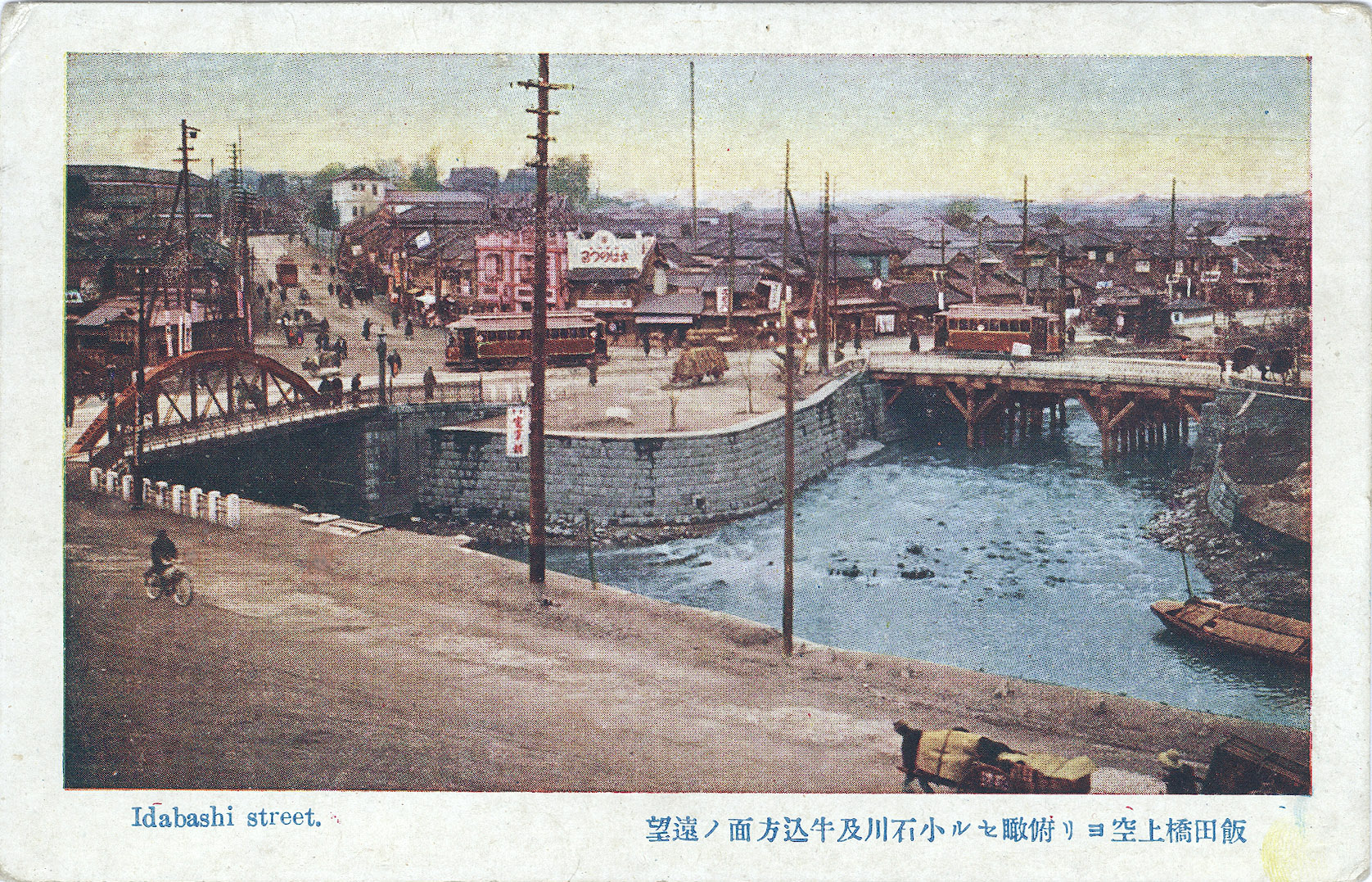
Iidabashi near Kagurazaka, Tokyo, c. 1920, at the confluence of the Kanda and Edogawa rivers nearby to Iidabashi Station on the Chuo Line. To the left is the road ascending to Ushigome Kagurazaka.
See also:
Kagurazaka, Tokyo, c. 1910.
Tokyo Arsenal, Koshikawa, Tokyo, c. 1920.
Chuo Rapid Line (neé Kobu Line), Tokyo, c. 1910.
“Of all of the districts in Tokyo, it is Kagurazaka that is seen as still possessing the kind of narrow streets the city had in the past.
“… During the first half of the twentieth century, Kagurazaka flourished as a hanamachi. For an enkai, a specific type of party held in traditional tatami-floored buildings, geisha would be invited through the okiya (geisha houses), and would dance and sing nagauta songs accompanied by a shamisen (a three-stringed wooden instrument), and drink with guests. This became seen as the most luxurious form of entertainment that could be had in Japan.
“There were several hanamachi in Tokyo, although the only ones left today are in Shinbashi, Akasaki and Kagurazaka. Even in Kagurazaka, the tradition has dwindled to the point of extinction.”
– Kengo Kuma: My Life as an Architect in Tokyo, by Kengo Kuma, 2021