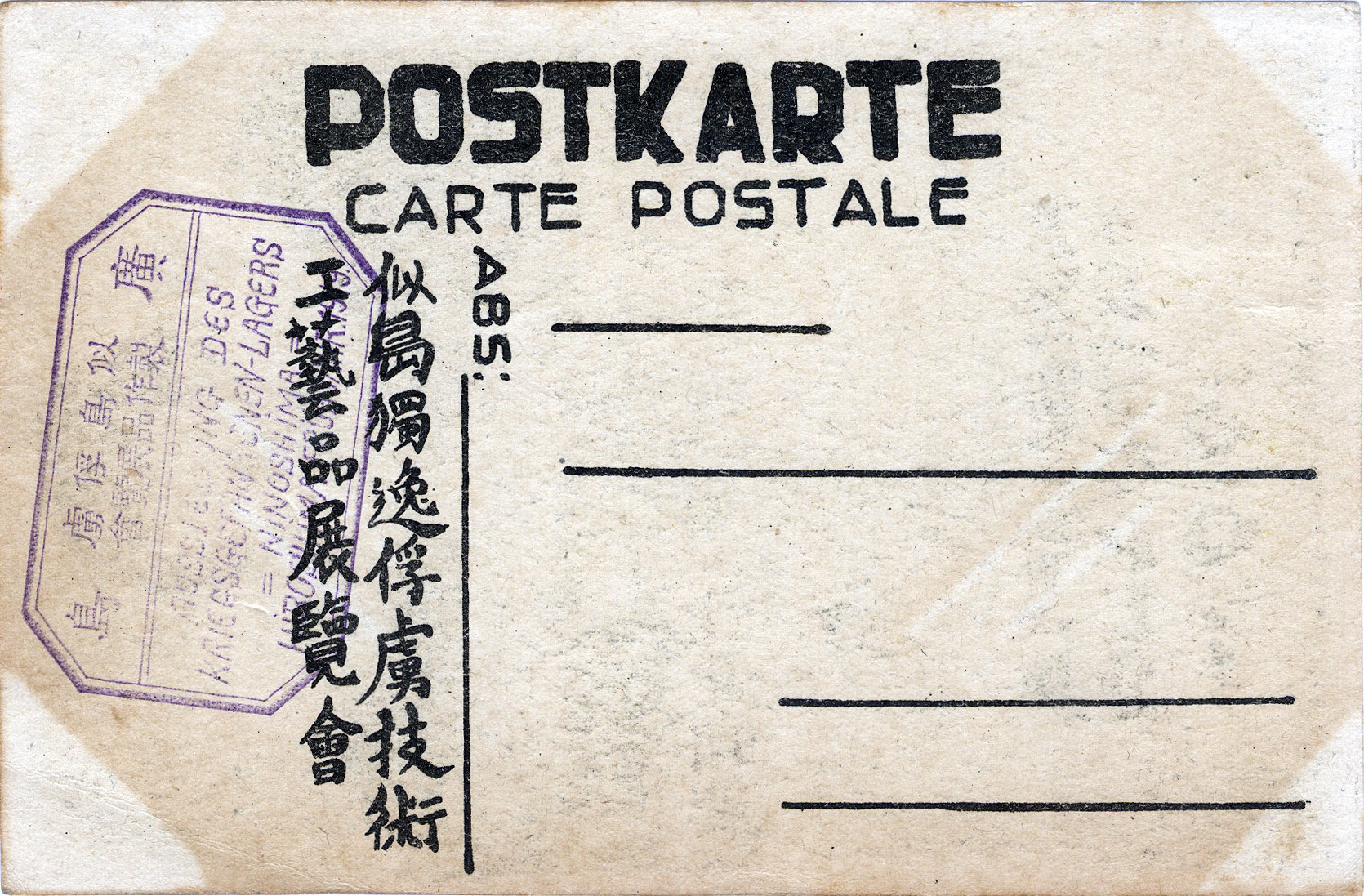

German POW art show advertising postcard, Ninoshima, 1919. More than 4,500 combatant German prisoners of war (POWs) were interned in temporary camps throughout Japan from 1914-1918, including Ninoshima near Hiroshima, and over a hundred former POWs chose to remain in Japan after the war ended in 1918. It was at this exhibition in 1919 where the German cake, Baumkuchen [“tree ring cake”] was first produced in Japan, and it quickly became the country’s most famous cake.
See also:
Ketel’s Restaurant, Ginza, c. 1935.
War prize German submarines, Yokosuka, c. 1920.
“During World War I when Japan sided with the Entente powers, Japanese troops captured over 4,500 German and Austro-Hungarian prisoners at the German colony of Qingdao, bringing them to Japan. In both these examples, Hague Convention guidelines for camp facilities were strictly adhered to.
“German POWs were incarcerated at Kurume, Anongahara (Hyogo-ken), Nagoya and Narashino (Chibaken), on Ninoshima Island (off Hiroshima), and Bando, Oita, Shizuoka and Narashino, the latter two previously holding Russians.
“… The general laxity of some camp regimes meant that German POWs were able to teach locals gymnastics and soccer, bake bread, make cheese, hold concerts and theatrical events, and print newspapers.
“Among over hundred orchestral performances held at the Bando and Tokushima camps between 1917 and January 1920, an orchestra led by Paul Engel famously performed Beethoven’s Ninth Symphony for the first time in Japan, on 1 June 1918.
“… Public exhibitions of prisoners’ arts and handicrafts became conduits to forms of early twentieth-century modernism already penetrating Japan. Atsushi Osturu describes a March 1919 exhibition, held in the recently completed exhibition hall, later renamed at the Hiroshima Prefectural Industrial Promotion Hall designed by Czech modernist architect Jan Letzel, where the Ninoshima Camp prisoners’ characteristically European handicrafts transported Japanese visitors to a seemingly European setting.
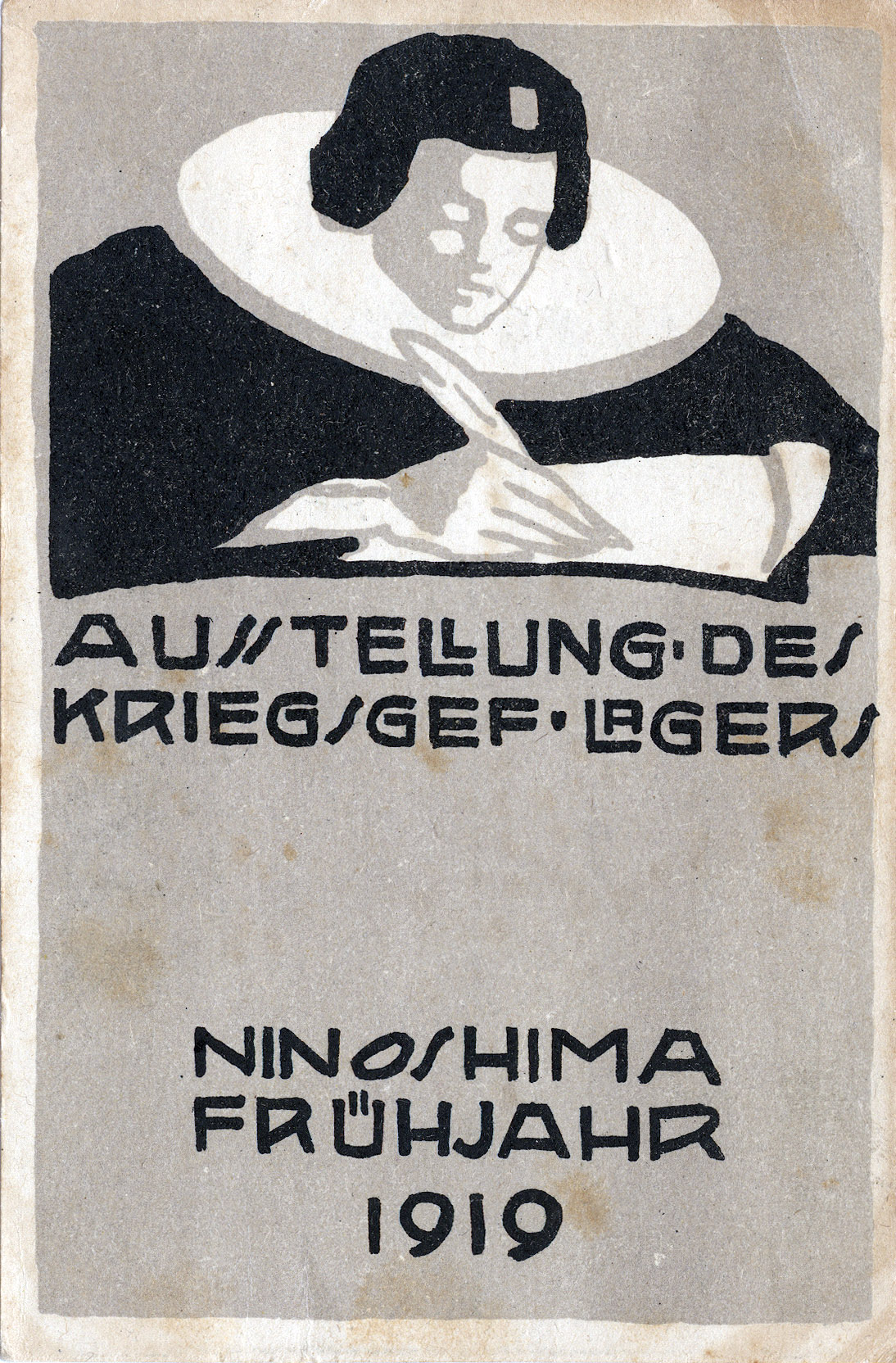
German POW art show advertising postcard, Ninoshima, 1919. Reverse side.
“The exhibition attracted over 10,000 visitors and the prisoners’ craftworks were almost all purchased, many by the exhibition center for their permanent archives.
“The building is familiar today as the Genbaku Dome, the ruined building marking the epicenter of the 6 August 1945 atomic bomb blast, which destroyed this collection.”
– The Architect of Confinement: Incarceration Camps of the Pacific War, Anoma Pieris & Lynne Horiuchi, 2022