

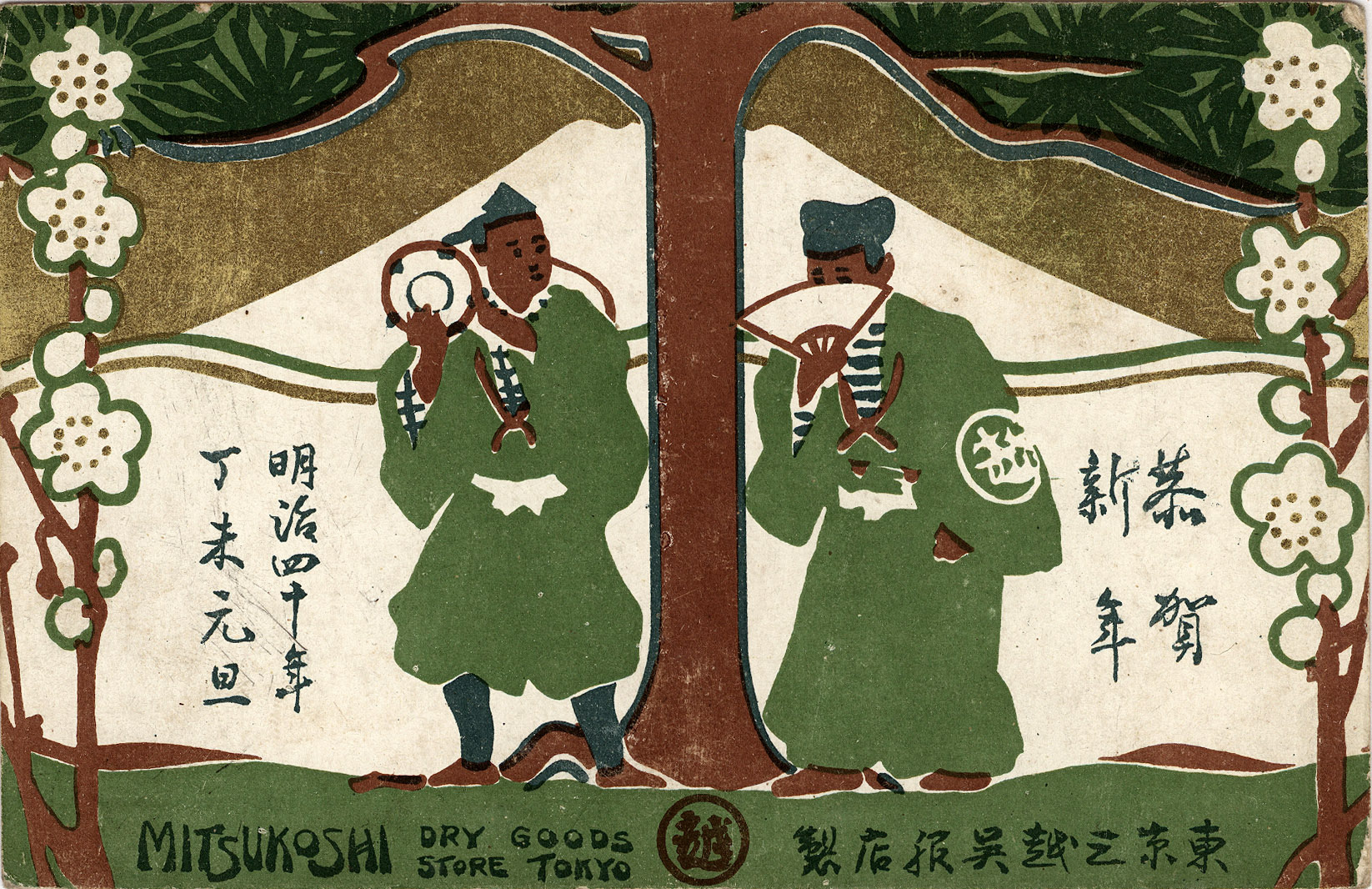
Mitsukoshi Dry Goods Store, New Year’s advertising postcard, Tokyo, c. 1905
See also:
Mitsukoshi Department Store, Nihonbashi, c. 1903-1923.
Roof Garden, Mitsukoshi Department Store, Tokyo, c. 1930.
Nozawa & Bros. department store, Yokohama, c. 1940.
Mitsukoshi Gofukuten [Department Store] helped revolutionize Japanese advertising by transitioning from traditional chindonya and nishiki-e to modern retail advertising, exemplified by the company’s 1905 “Department Store Declaration” and the establishment soon-thereafter of an in-house art department set up along the lines of Western retailers, led by designer Sugiura Hisui.
Prior to this, the retailer had been a family concern known as Echigoya, established in 1673 by Mitsui Takatoshi, specializing in kimono and fabrics, who had pioneered the idea of fixed-price retailing to their Edo period customers more than 200 years before.
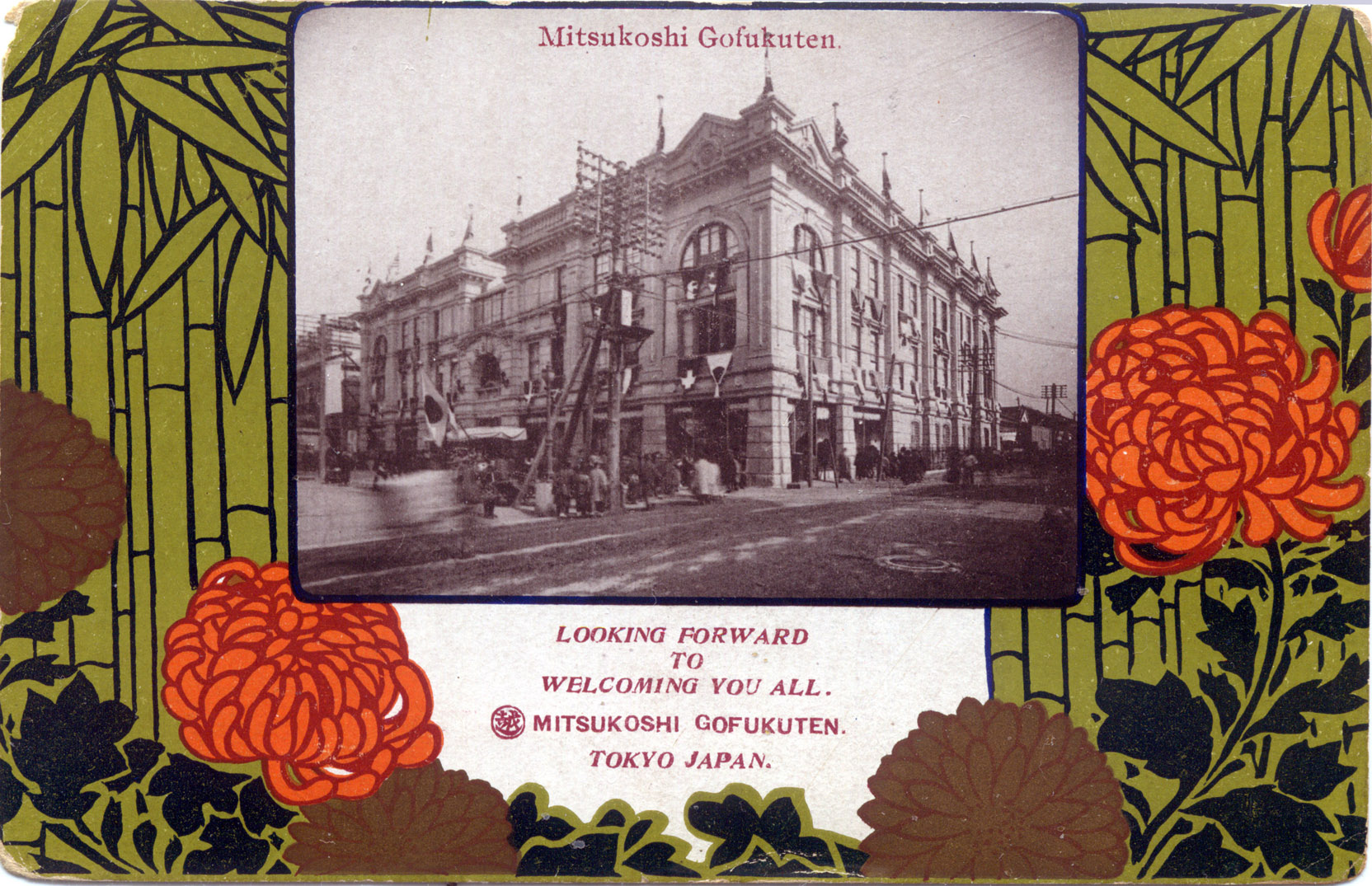
Mitsukoshi Gofukuten advertising postcard, c. 1905.
In 1904, Echigoya became Mitsukoshi Gofukuten, making its dramatic announcement (titled the “Department Store Declaration”) with a full-page advertisement in all the major magazines and newspapers. It adopted the term depātoento sutoa [the Japanese transliteration of “department store”] to fully embrace Western retailing.
Key to this strategic pivot was the establishment of Japan’s first in-house retail art department, employing graphic design pioneer Sugiura Hisui. Unlike smaller retailers who used simple flyers or text newspaper notices, Mitsukoshi produced elegantly designed brochures and illustrated catalogs, as well as commissioning high-quality works by notable artists in pursuit of a cultured brand image.
Albeit its marketing focused almost exclusively on the affluent customer, Mitsukoshi’s advertising attracted large numbers of the middle-class through the doors, drawn there by the novelty of it all – including a small rooftop zoo.
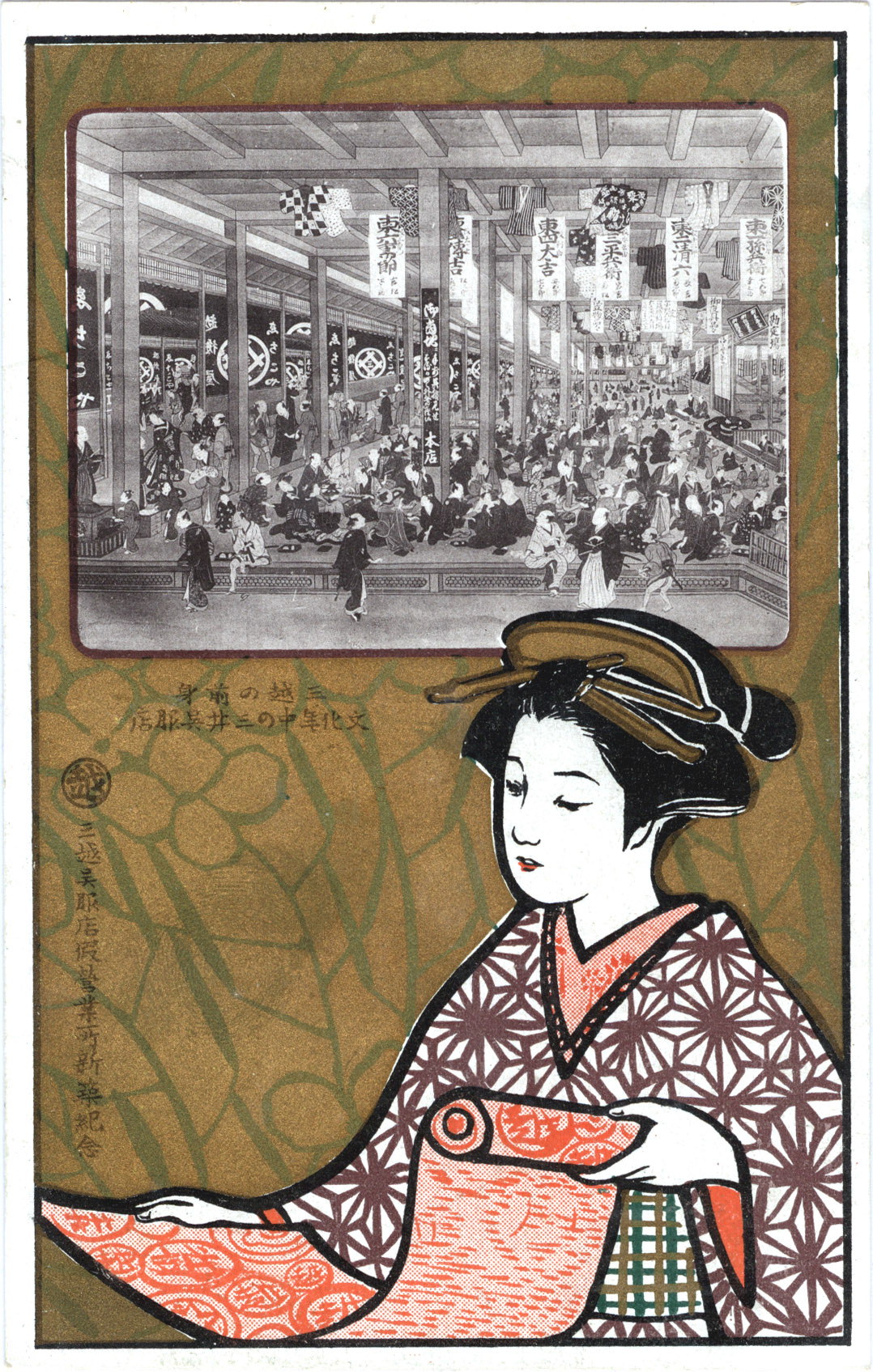
Mitsukoshi Gofukuten advertising postcard, Nihonbashi, c. 1905. The inset illustrates the gofukuten store premises during the Edo period, before the store was redeveloped in 1904 into a Western-style “department store”.
Mitsukoshi ran seasonal pattern exhibitions and artistic displays — advertising the store as a place to learn about modern design and proper taste, not just to buy goods. The department-store experience was framed as cultural and civic (civilization/enlightenment), which attracted a new urban female consumer.
Mitsukoshi’s posters and postcards drew on contemporary European styles (Art Nouveau and modern illustration) and employed attractive single-figure images (bijin-ga and allegorical women) to associate the store with modernity and elegance — a visual language smaller vendors rarely used.
The store’s ads worked to make Mitsukoshi a civic cultural institution (a public urban place of refinement), rather than simply a place to transact. That institutional positioning was central to its advertising strategy and differentiated it from neighborhood drapers and specialty shops.
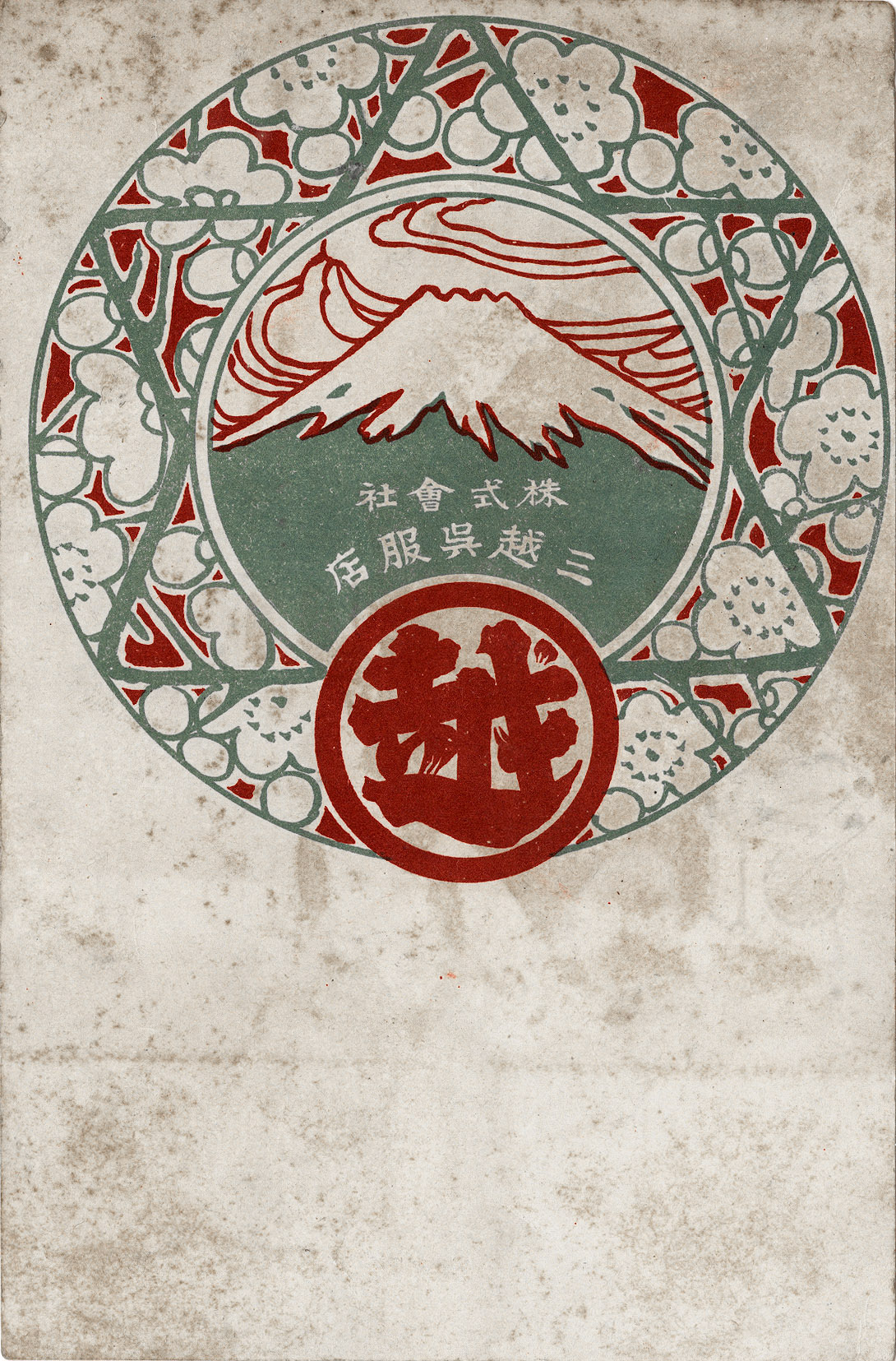
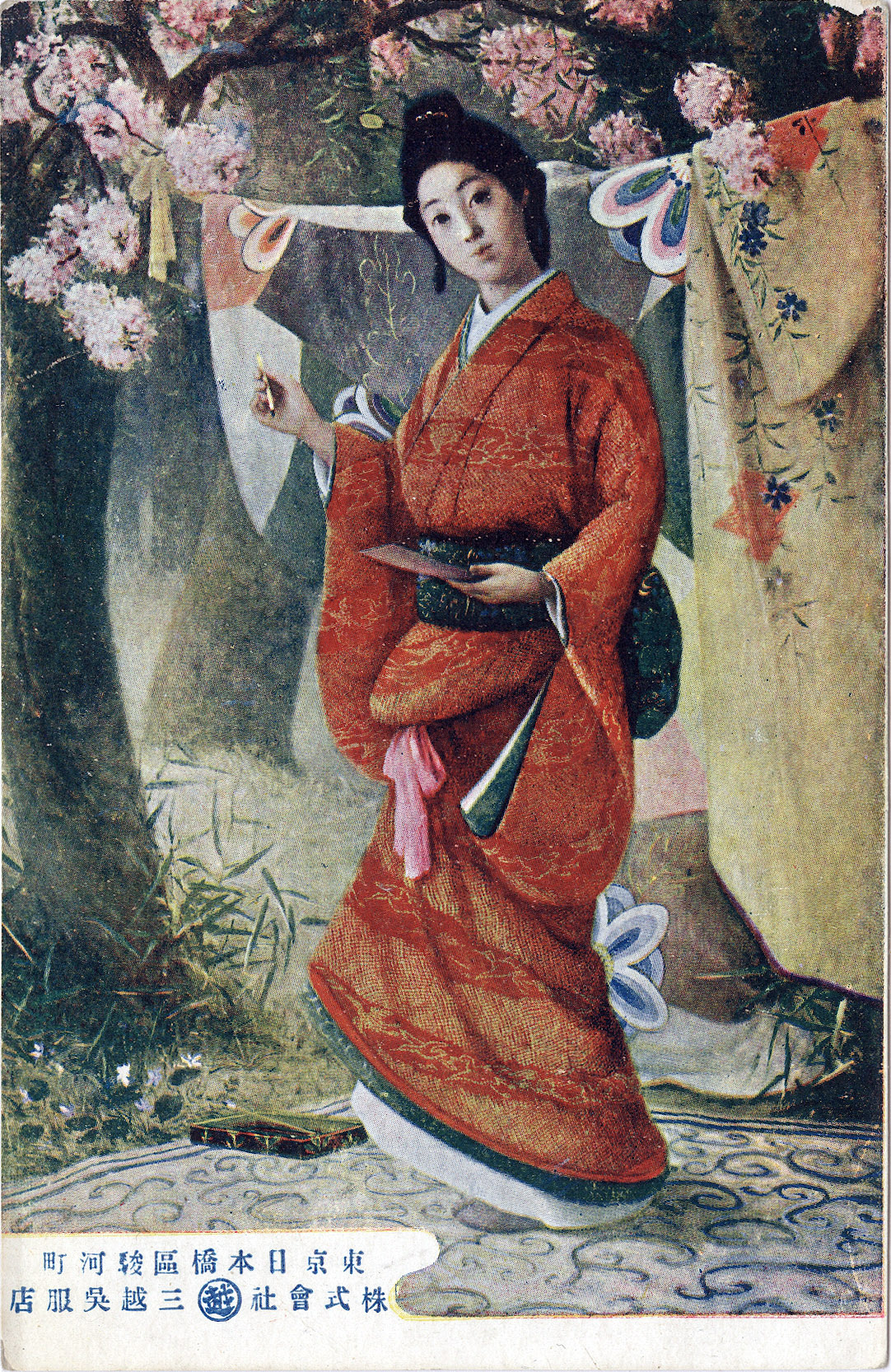
Mitsukoshi Gofukuten advertising postcard, c. 1905.
-
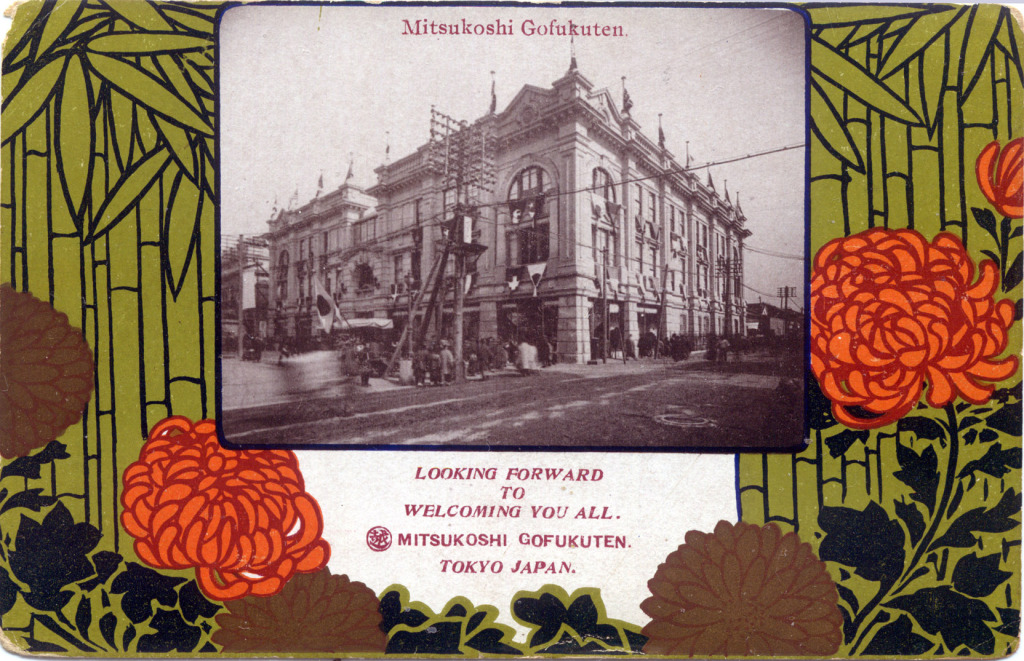
- Mitsukoshi Gofukuten, Nihonbashi, c. 1908.
-
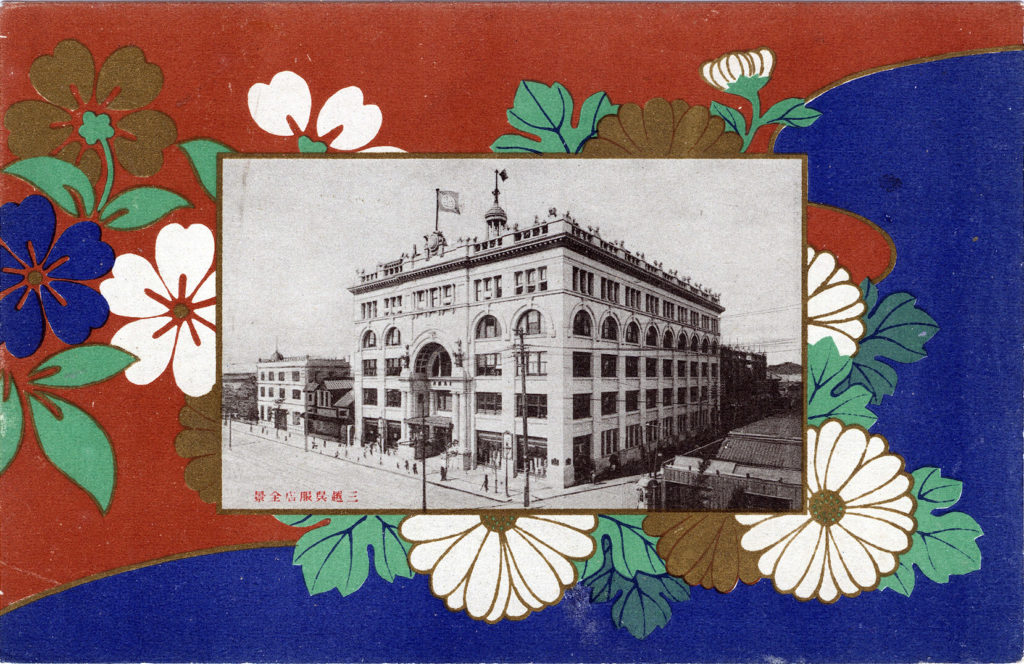
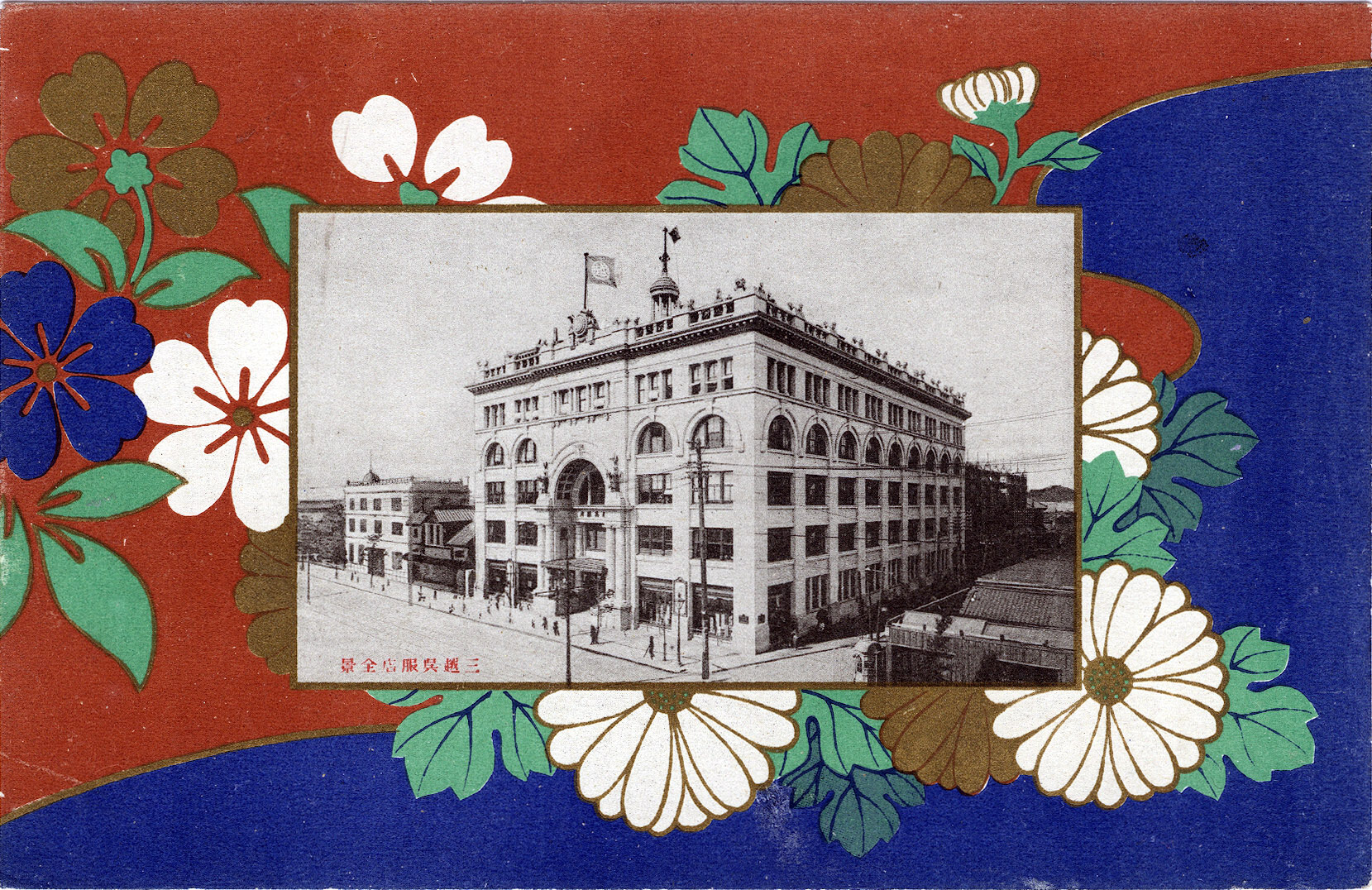
- Mitsukoshi department store, Nihonbashi, Tokyo, c. 1915.
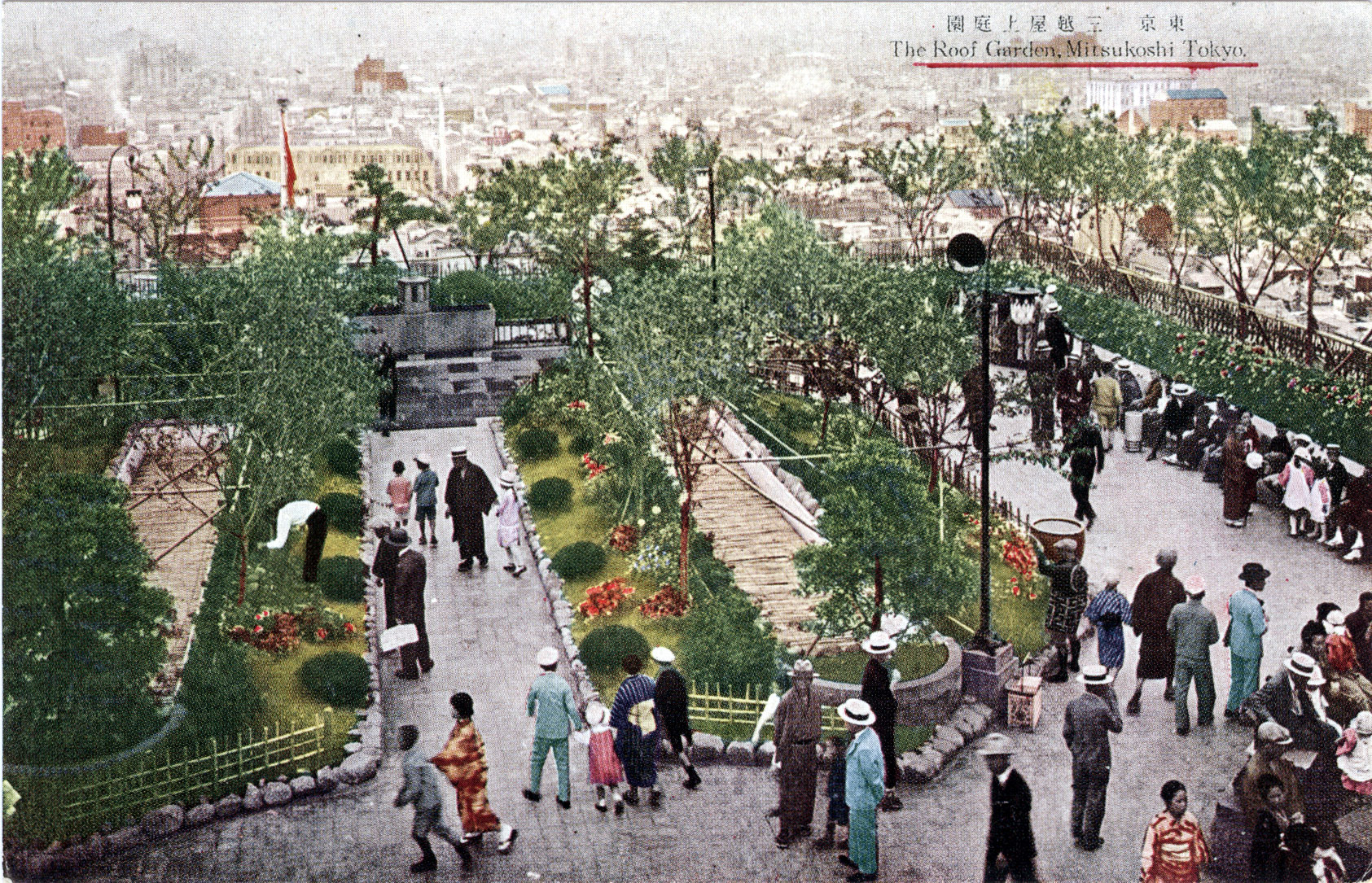
Roof garden, Mitsukoshi department store, c. 1930.
“Before Mitsukoshi became the modern department store we know it to be today, it was a dry goods store in Edo, established in 1673 by Mitsui Takatoshi (1622–1694), specializing in fabrics and clothing. Echigoya, the name by which the store was known at the time, always defined the cutting edge of innovation.
“In his overview of Mitsukoshi’s management strategies, Takahashi Junjirō mentions that Takatoshi’s most significant innovation was his restructuring of the system of buying and selling … [A]fter moving to Suruga-chō, the merchant district of Edo, Echigoya’s clientele shifted [from wealthy aristocrats] to townsmen and merchants. This change would lead to Takatoshi’s restructuring of the way people consumed products.
“First, customers were expected to settle their bill on the spot and in cash (tanasaki gengin-uri). Second, Takatoshi introduced fixed prices and abolished price negotiations, thereby creating an image of affordability and reliability.1
“However, this public image was completely turned around in 1904, when the store took its official name of Mitsukoshi Gofukuten and declared itself a modern department store in all the major magazines and newspapers.
“This so-called depātomento sutōa sengen (Department Store Declaration) was the start of an entirely new type of store, one that focused not on affordability but on luxury. From this moment forward, Mitsukoshi started to position itself not only as a leader in the retail industry but also as a public guide to social etiquette through consumption.
“Three men in particular were instrumental in this transformation: the first general manager of the store, Takahashi Yoshio (1861–1937); his successor, Hibi Ōsuke (1860–1931); and Hamada Shirō (1873–1952), the first head of marketing at Mitsukoshi. All three belonged to the cultural and economic elite, and had studied business in the United States and Europe.
“Based on their Western counterparts, these three men would change the face of Mitsukoshi forever, and their main focus was consumer psychology and the ways to influence it through aggressive marketing campaigns … playing on the insecurities of the new middle-class consumer in a modernizing society.”
– A Sign of Good Taste: Mori Ōgai, Mitsukoshi, and the Concept of Shumi, by Jurriaan van der Meer, 2022