
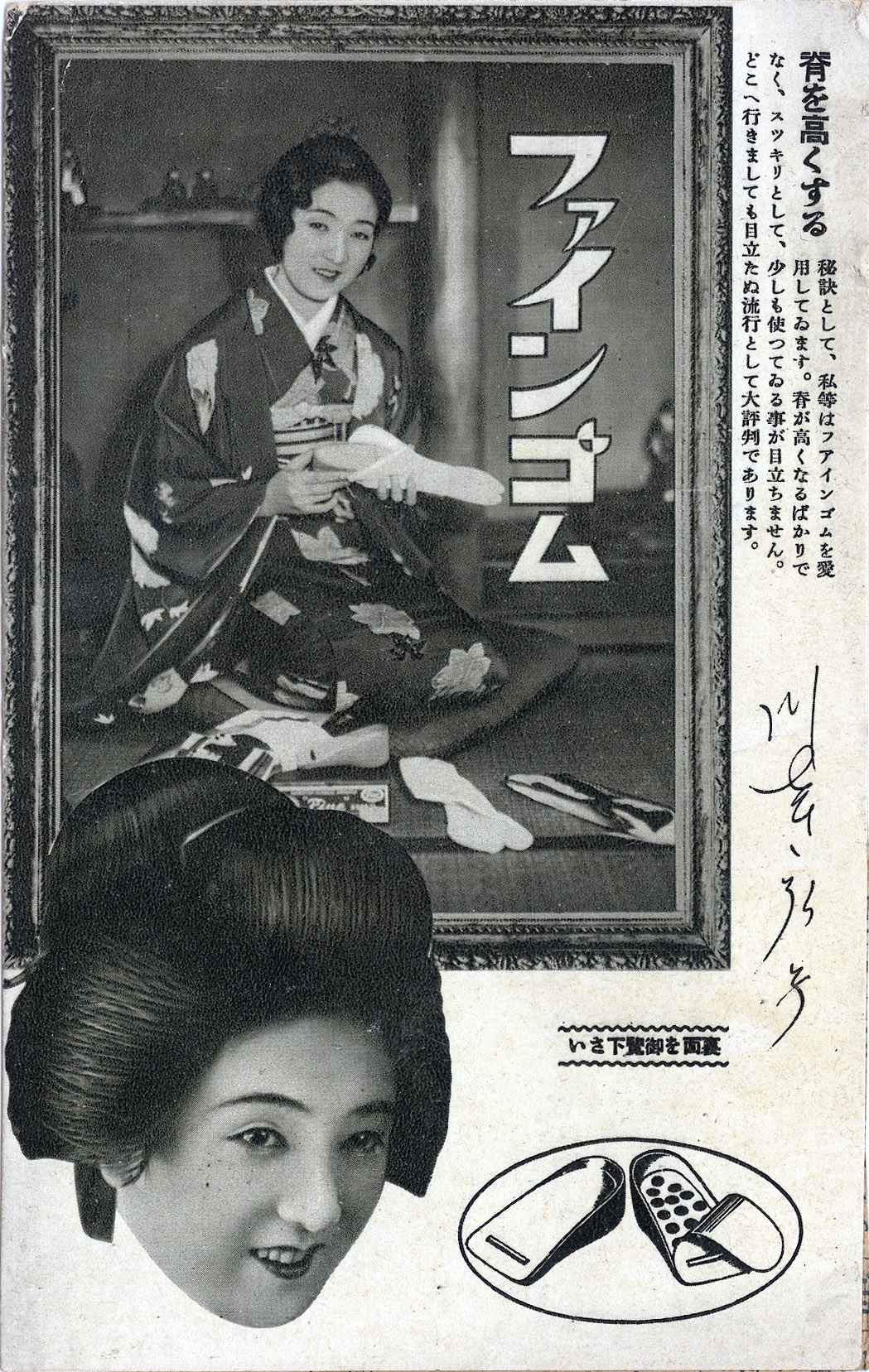
“Stand Tall”, Fine Rubber shoe or zori inserts/lifts advertising postcard, c. 1930, a synthetic rubber product manufactured by the Small Goods Rubber Manufacturing Co., Nihonbashi, Tokyo and sold through a variety of retailers including the Matsuzakaya and Shirokiya department stores “and other haberdasheries”. Endorsing the product on this postcard is Kawasaki Hiroko, a popular Shochiku motion pictures actress in the 1930s. Caption: “The secret is to use Fine Rubber. Not only does it increase your height, but it’s also neat and tidy, and completely invisible. Wherever you go, it’s popular and discreet.”
See also:
Nippon Tabi Co. Ltd., Kurume, Fukuoka, c. 1930.
“Pulling the sled”, c. 1950. Unknown woodblock artist.
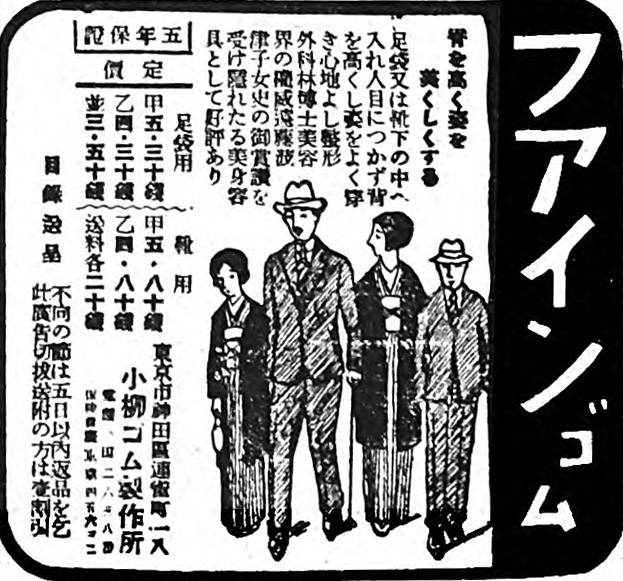
“Fine Gum” newspaper advertisement, Osaka Asahi Shimbun, 1928. for the Small Goods Rubber Co., Nihonbashi, Tokyo. “Slip them into your tabi or socks -— discreet — they protect the heel well and prevent fatigue. Sold in sets of five.”
Zōri (Japanese sandal) wearers sometimes added “fine rubber” heel pads or lifts to enhance their appearance. Rubber inserts also made tabi last longer or be worn more comfortably. “Fine” might have been used as a trade description of the rubber grade, known as fine crumb rubber or fine rubber powder, used for injector-molding the inserts.
Rubberized footwear was advertised as hygienic, “scientific”, and modern. School uniforms often included rubber-soled tabi (thick ankle sock). Construction workers used the more thickly-soled jika-tabi (ground tabi), newly introduced in the 1920s by Nippon Tabi Co..