

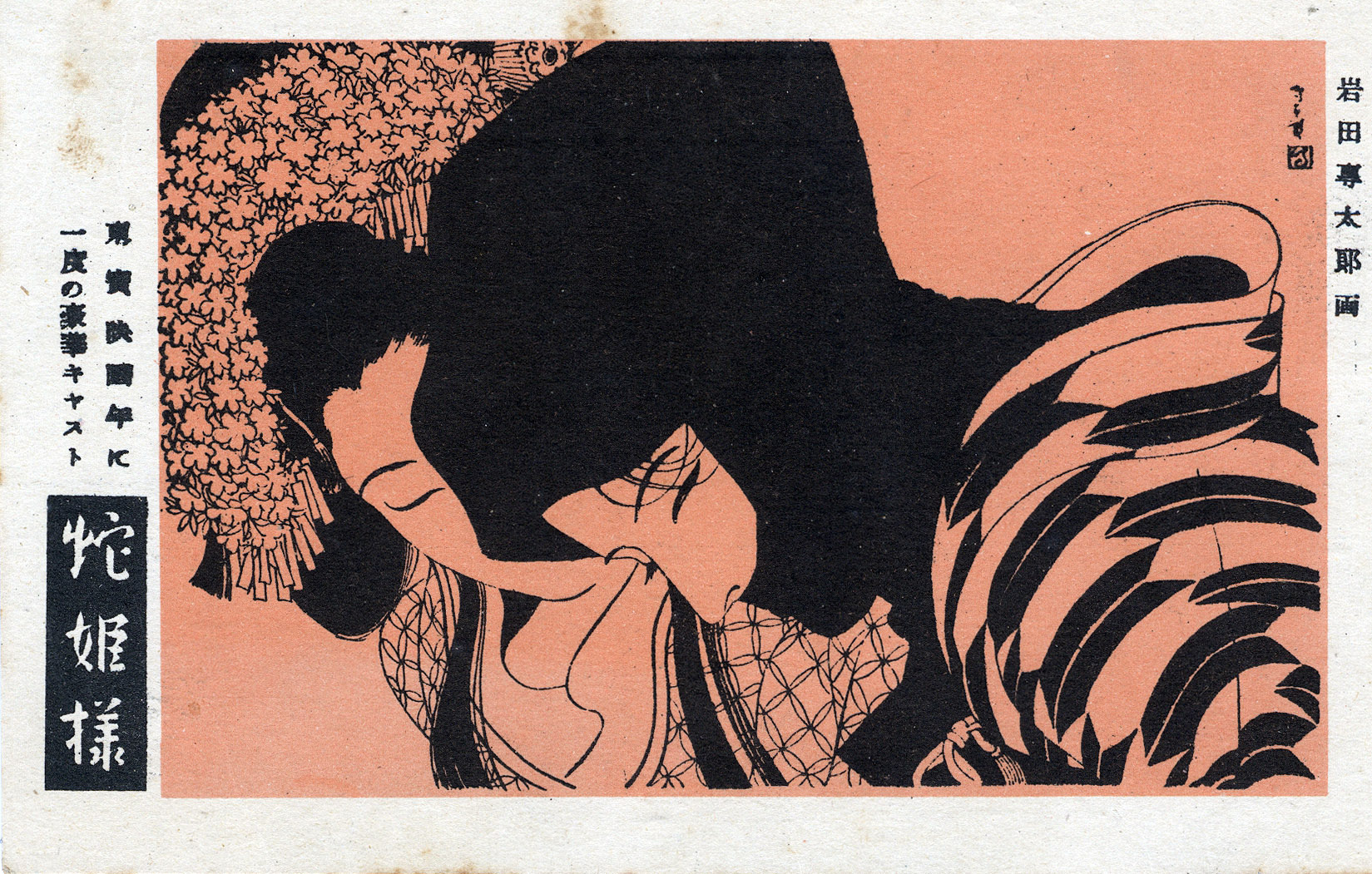
“Snake Princess” (Hebihime-sama), Toho Movie Studios promotional postcard, 1940.
See also:
Tokyo-Takazaruka Eiga K.K. (Tokyo-Takarazuka Motion Picture Co.) studio, c. 1938.
“Tokyo Matsuri” advertising postcard, 1933.
“Gekimetsu” (“Annihilation”) motion picture advertising postcards, 1930.
Hebihime-sama (“Snake Princess”) was the first installment of a two-part serial motion picture. “Part One” was released by Toho Eiga in April, 1940 with its second installment released in August, 1940.
Its release was promoted as a Toho “all-star” prestige film, an effort by Toho to rival Shochiku and Nikkatsu in mounting high-class jidai-geki [“period dramas”] productions with marquee value.
The film story was adapted from artist Matsutarō Kawaguchi’s 1939–40 newspaper serial of the same name. Set in the castle town of the Karasuyama domain, a corrupt senior retainer schemes to seize power. After his father, a loyal retainer of the daimyo (provincial lord) is murdered, a townsman Sentarō (Kazuo Hasegawa), kills the culprit and goes on the run, falling in with a troupe of traveling actors. Meanwhile the loyal maid O-Suga and Princess Koto (Setsuko Hara) get drawn into the intrigue as allies work to expose the plot and restore order.
Topping the bill was actor Kazuo Hasegawa, arguably Japan’s top male film star at the time. He had been a leading man at Shochiku since the late 1920s, then moved to Toho in 1937 in a highly publicized contract shift.
Actress Setsuko Hara was only 19–20 years old at the time of filming, but was already being promoted as the “New Face of Toho”. She had first gained attention for her role in Arnold Fanck’s German-Japanese coproduction The Daughter of the Samurai (Atarashiki tsuchi, 1937, starring Sessue Hayakawa). Hara would later become one of the most iconic actresses in Japanese film history, famous for her roles in movies directed by Yasujirō Oz in the 1950s and 1960s until retiring in 1962.
The director, Teinosuke Kinugasa, who joined Toho in 1930, was one of the most important figures in early Japanese cinema — both a pioneering filmmaker and a link between the silent era and postwar prestige cinema. Kinugasa began his career as an onnagata (male actor playing female roles) in the kabuki tradition, then transitioned into film acting during the 1910s before becoming a film director. Among his early directorial successes was Crossroads (Jûjiro, 1928). a stylized jidai-geki for which Kinugasa also wrote the screenplay, that gained wide international recognition including a screening in 1928 at the Venice Film Festival.
Postwar, Kinugasa directed Gate of Hell (Jûjiro, 1953), a lavish color period drama that won the Palme d’Or at Cannes and the 1954 Academy Award for Best Foreign Language Film, making it the first Japanese film to win an Oscar.