

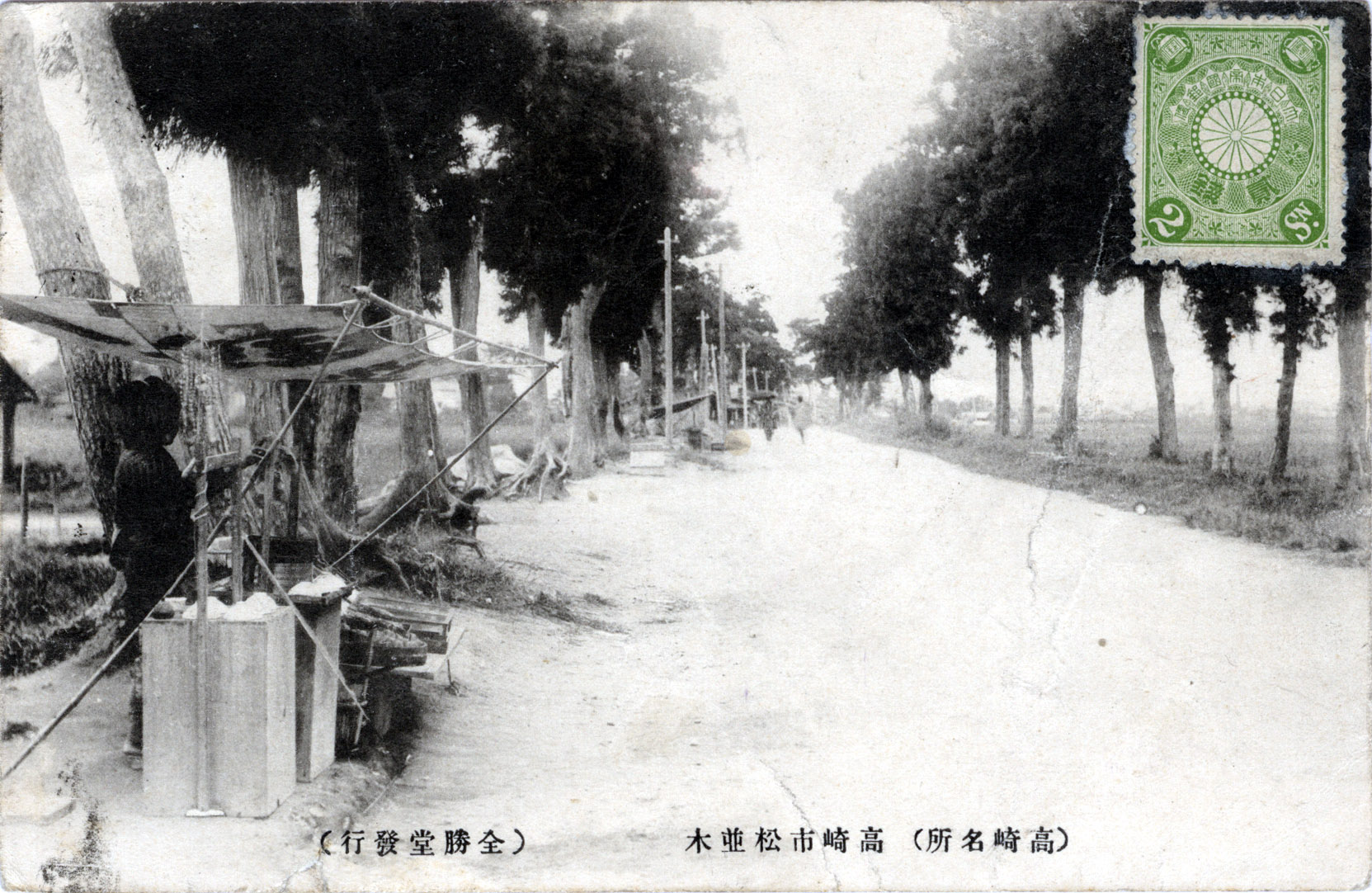
“Pine Tree Avenue”, Takasaki, Miyazaki Prefecture, c. 1910. Planted during the Edo period along Japan’s five main highways, long “avenues” of pine trees provided travelers with protection from the wind, and harsh winter and summer weather, and shelter for itinerant roadside vendors (as seen above). Today, in the broader Miyazaki region, there remains a pine-lined 10-mile stretch that’s often described as a “natural avenue” along a section of the Kenritsu Awakigahara Forest Park shore.
In 1604, Ieyasu, the first Tokugawa Shogun, decreed to his provincial magistrate, Okugo Nagayasu, that the Gokaido (the five main highways, e.g., Tokaido, Nakasendo, etc.) be lined with pine trees.
The resulting “pine tree avenues”, oft-depicted in ukiyo-e, were planted by the hundreds along the main highway shoulders to protect travelers from wind and snow in winter, and to provide foliage and shade in summer.
A popular Edo-era illustrated series, “Hizakurige on the Tokaido”, has a pine tree avenue as the scene of pranks by a mischievous fox.