

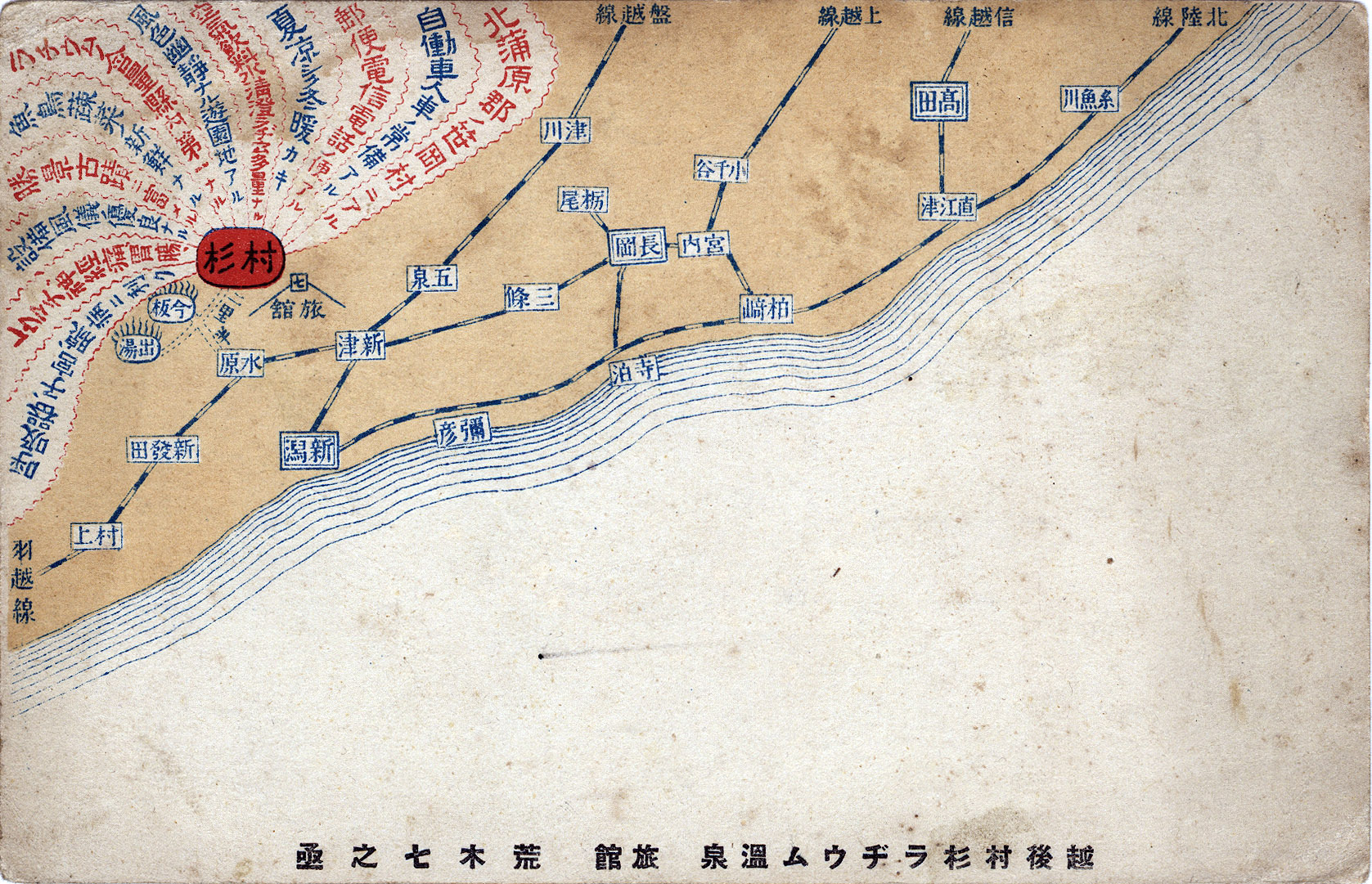
Murasugi Radium Hot Springs advertising postcard, Niigata, c. 1920, published by the Araki Shichinojo Inn, showing the nearest train stations (Niitsu and Mizuhara) and other means of area transportation including bus and automobile. (The first shared-ride car in Niigata Prefecture, a six-seat Ford Model T operated by inn owners, was operated on a regular basis between Mizuhara and Murasugi.) Tucked away in the rice fields and forested hills forming the Gozu (“Five Heads”) hot-spring area in Niigata Prefecture, the Murasugi radium hot springs are said to be over 700 years old, with legends date their discovery to the 14th century. The Araki family name is strongly associated with Murasugi — several local histories say many villagers used the Araki surname and that an Araki ancestor is traditionally credited with discovering the spring centuries earlier.
“My motivation for discovering and announcing that the spring within the precincts of Murasugi Yakushi-do contained a large quantity of radium emanation began in March of the second year of the Taisho era [CE 1913].
“… Circling the village, ancient cedars and pines stand tall. The entire post station comprises forty-three households. Most operate hot spring inns; those who do not devote themselves to farming. The residents are simple and honest, the entire village like one family.
“Most villagers do bear the surname Araki. Tradition holds that Ashikaga clan retainer Araki Masataka first discovered this hot spring here … in the spring of Kenmu 2 [CE 1335], some six hundred years ago. The mineral spring yields approximately nine hundred koku [~43,000 gallons] daily, bubbling forth beneath the mountains beside the Yakusho-ji temple. Its color is clear and pure, odorless and tasteless.”
“… While leading students from a specialized school on a trip to the same location for rabbit hunting, I stayed at the residence of Mr. Shichinojo Araki. During bathing, I suspected the cause of the spring’s lack of medicinal properties [was] its scarcity of the characteristic mineral components [of other baths]. [I]t is well known that this spring water has remarkable effects on bruises, rheumatism, neuralgia, and other ailments.
“After much deliberation, I imagined that it might be due to the action of radium emanation, similar to the Stein mineral springs in Austria, which were called the divine spiritual springs. I conducted an experiment using a radium testing machine, and found sufficient sensitivity in the laboratory.
“I discussed this matter with Mr. Shiro Kobayashi, editor-in-chief of the Niigata Shimbun, and we traveled together to the site. We conducted dozens of experiments there, confirming its effectiveness. In July, we gathered local residents for a lecture and published a report in the leading newspapers of the prefecture.
“… [S]ubsequent investigations revealed that Japan is unexpectedly rich in radium, and among the hot springs and mineral springs located here, there are several that rank higher than this spring in terms of emanation content. Nevertheless, springs with such a high volume of discharge as this one are unparalleled.
“Moreover, in Murasugi, similar concentrations are found not only in the spring water within the precincts of Yakushi-do Temple but also in the stream flowing through the village. Therefore, in terms of cumulative quantity, it can be said to be almost unmatched in the world.”
– On the Discovery of Radium and Ammonia at the Murasugi Spring. by Ran Nakayama, Professor at Niigata Medical College, 1914.