

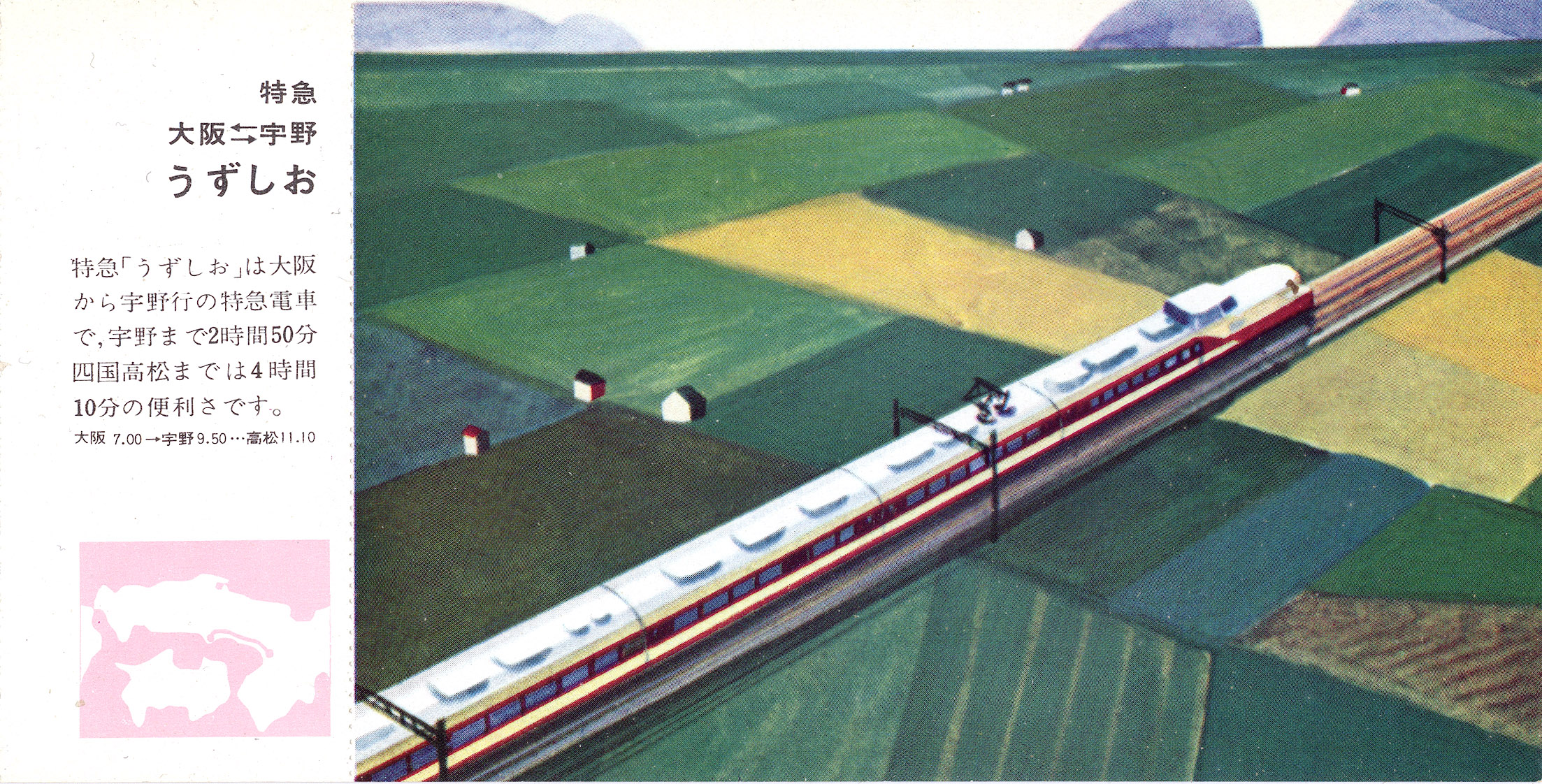
Limited express “Uzushio” promotional postcard, 1961. Inset lower-left displays the Osaka-Uno route. The caption reads: The Limited Express “Uzushio” is an express electric train running from Osaka to Uno, offering a convenient travel time of 2 hours and 50 minutes to Uno and 4 hours and 10 minutes to Takamatsu (in Shikoku).
See also:
J.N.R. Tokaido Main Line Limited Express commemorative advertising postcard, October 1958.
Kyoto-Matsue “Matsukaze” express train advertising postcard, 1961.
“Uzushio” [Whirlpool] was a limited-express operated by the Japan National Railroad (J.N.R.) connecting Osaka to Uno with onward ferry connections to Takamatsu, Shikoku (near the Naruto whirlpools, hence the name). Service was introduced in 1961 and operated until 1972, operating J.N.R’s new Class 151 EMU which offered a seamless limited-express link between the islands of Honshū (Osaka area) and Shikoku via the J.N.R.-operated Uno ferry.
Before the 151-series, EMU’s were seen mainly as commuter stock not suitable for long-distance express passenger travel. Even though most city rail lines had been electrified for decades, J.N.R.’s fastest express trains still operated steam or diesel-fueled locomotives into the 1960s.
The Class 151 units proved that an EMU (electric multiple unit) could run a sustained long-distance express service (Tokyo–Osaka, 500 km) at sustained speeds exceeding 110 km/h — a world first at the time. Travelers could now make a round-trip between Tokyo and Osaka in one day, a goal first envisioned in the 1930s with the introduction of the streamlined C55 locomotive.
The technical and operational experience gained from developing the Class 151 EMU led directly to the introduction of the 0-series Shinkansen to serve the Tokaido Mainline corridor between Tokyo and Osaka, becoming the world’s fastest train when commissioned into service in 1964. After 1964, Class 151/161/181 EMUs continued as limited-express service providers in the corridor and on branch lines. Most were retired in 1982.