

“The town people [of Nagasaki] were out in holiday attire to take the air and look out on the bay and stare at the General. After we had made our tour of the fairgrounds the Governor asked General and Mrs. Grant to plant memorial trees.
“The species planted by the General was the Ficus religiosa [‘sacred fig tree’], while to Mrs. Grant was given the Saurus camphora [‘camphor tree’]. The Governor then said that Nagasaki had resolved to erect a monument in honor of General Grant’s visit, that this memorial would be near the trees, and that if the General would only write an inscription it would be engraved on the stone in English and Japanese characters. The General wrote the inscription as follows:
‘At the request of Governor Utsumi Tadakatsu, Mrs. Grant and I each planted a tree in the Nagasaki park. I hope that both trees may prosper, grow large, live long, and in their growth, prosperity and long life be emblematic of the future of Japan’.”
– Around the World with General Grant, Vol. 2, by John Russell Young, 1879
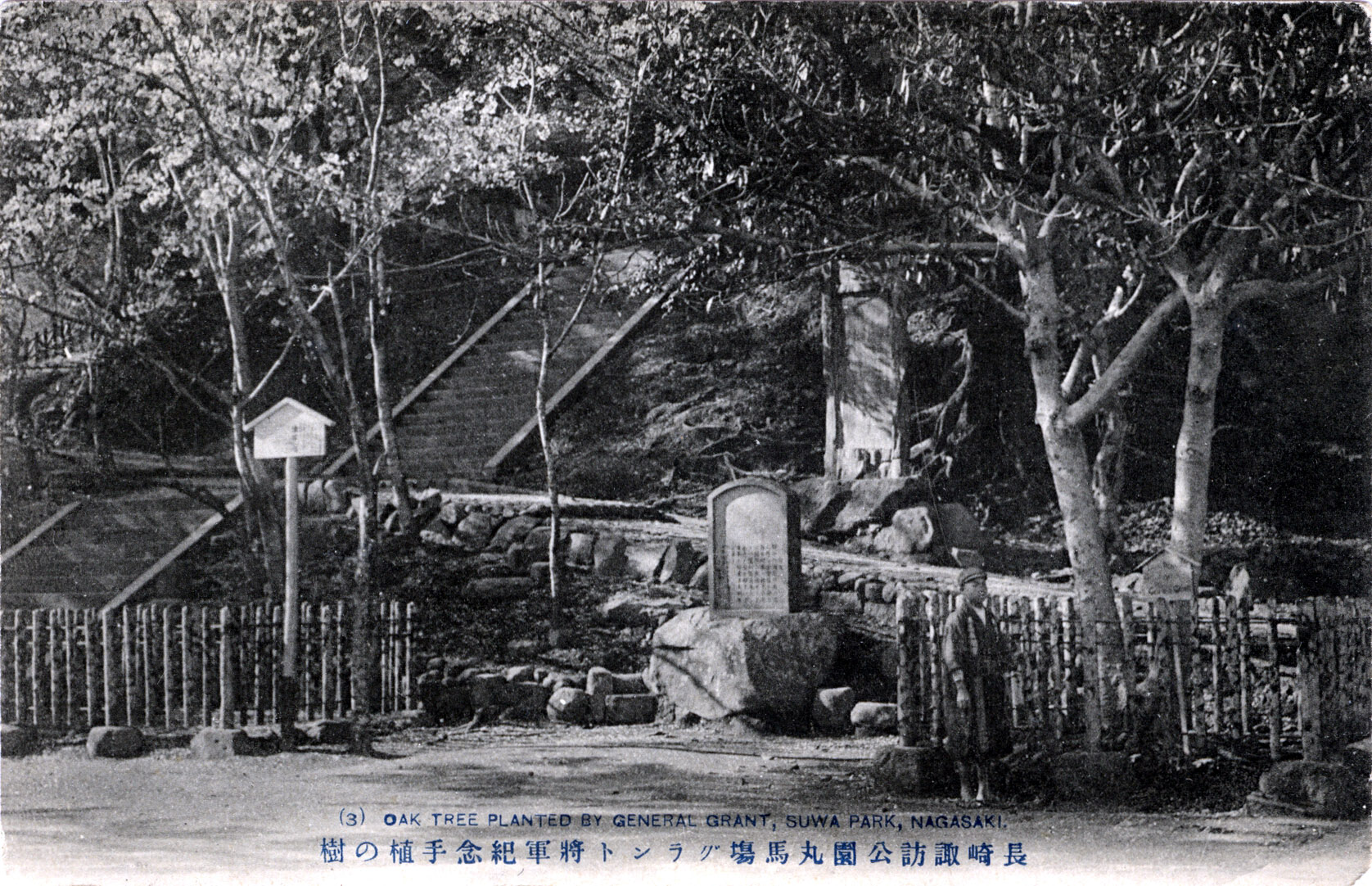
General Grant Tree and memorial stone, Nagasaki, c. 1910. Two trees was planted in commemoration of former U.S. President U.S. Grant’s visit to Japan during his “retirement” tour. Originally planned to be a private affair, Grant’s tour grew to assume diplomatic proportions when the Hayes administration encouraged him to voyage around the world to promote American interests abroad. In addition to meeting Emperor Meiji, U.S. Grant dined with Queen Victoria, and had audiences with Tsar Alexander, Pope Leo XIII, and other leaders.
See also:
Emperor Meiji meets General Grant, 1879.
“Nagasaki (AP) – Today we have bad news for General Grant. Some scalwags cut down his old banyan.
“They not only cut it down – they piled the site high with stone and rubble … Twings, leaves, trunk and memorial tablet all vanished – the Grant banyan is gone, a casualty of the second world war.
“… Glenn Rabb, Associated Press foreign editor, learned that Grant’s banyan memorial had been cut down with several other trees three years ago [1942] to make space in which to dump dirt and stone from air raid shelters dug in the surrounding hills. Neither park or adjoining temple shrine was affected by the atomic bomb, which exploded several miles away. No trace of Grant’s banyan tree or memorial tablet, both victims of the American air campaign, is left.”
– Lawrence (KS) Journal-World, November 15, 1945