

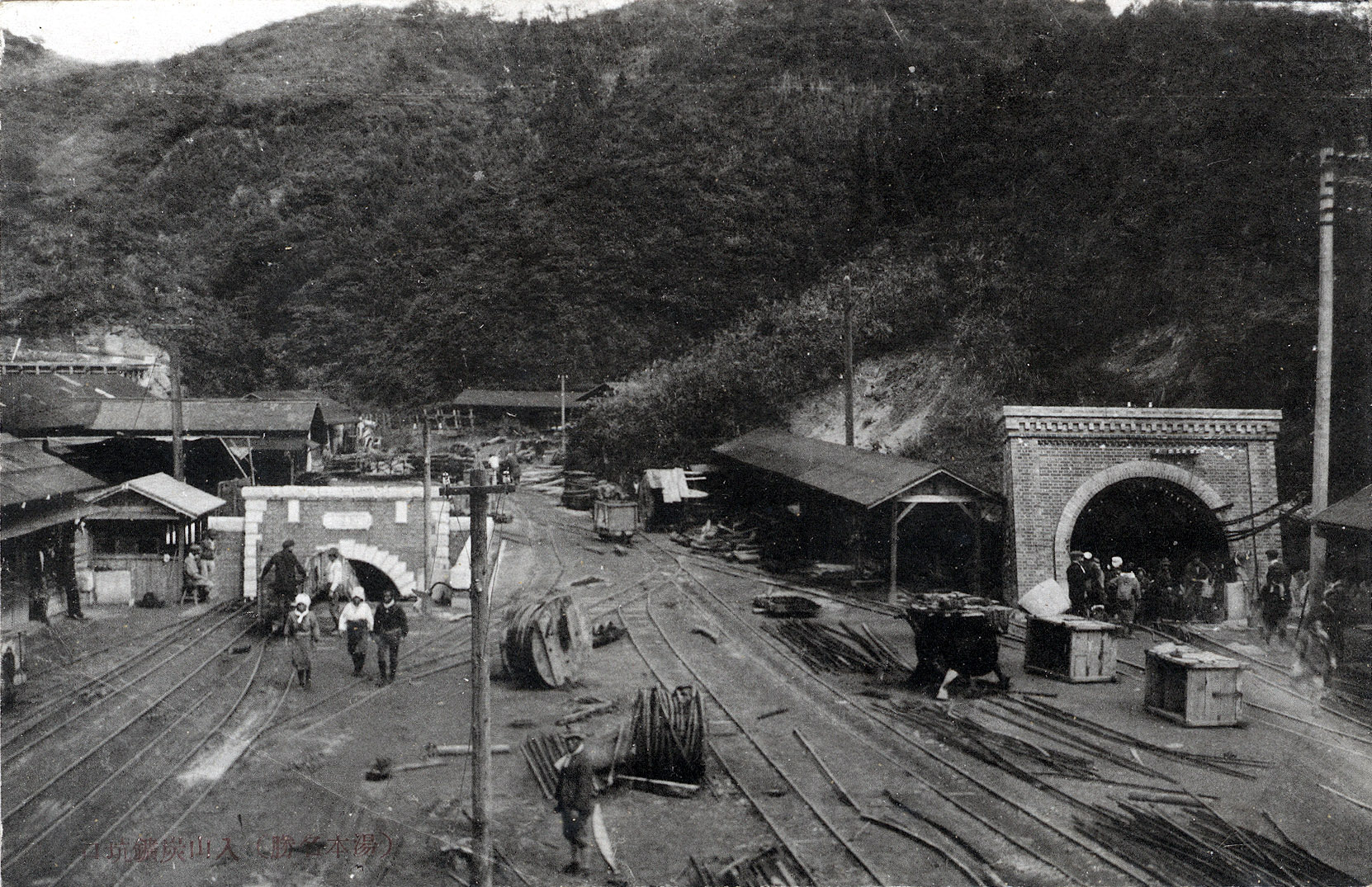
Entrance to the Inyama Mine, Joban Coal Field, Fukushima, c. 1920. Mining the Joban coal field was a major source of coal production in Japan during the first half of the 20th century. The south field was opened for mining in 1851; the north field opened in 1855. in 1883, the Iwaki Coal Mining Company was established by prominent Meiji era business giants, including Eiichi Shibusawa, Sōichirō Asano, and Kihachirō Ōkura, among others — marking the beginning of the field’s modern industrial exploitation.
See also:
Kosaka Copper Mine, Kosaka, Akita Prefecture, c. 1920.
Gifu Prefectural Museum of Natural Resources, Gifu City, Gifu Prefecture, 1908. (Colorized)
Many of Japan’s larger and better known mineral mines date back to the early centuries of the Common Era. The impetus for mining Japan came about with the growth of Buddhism, A. D. 600 to 700, and its attendant need for copper and other metals necessary for the making of temple ornaments and the creation of statues.
During the early feudal period, between 1333 to 1568, mine operations were expanded to meet the demand for ornamental metals and for financing of campaigns. After the removal of the seat of government from Kyoto to Tokyo, about 1600, the Tokugawa Shogunate placed great emphasis on mining. Many new mines were opened, some of which are still operating.
Toward the end of the Tokugawa period, mining had declined sharply from its earlier peak. The easily worked, high grade portions of the ore bodies had been exhausted, and the mining techniques then available could not exploit the deeper, lower-grade ores. With the Meiji Restoration in 1868 and the rapid opening of the country to Western ideas came a rejuvenation of the mining industry.
Mining, milling, and smelting processes were greatly improved during the Modernization, resulting in the extension of new extraction technologies into hitherto inaccessible portions of ore bodies. Mechanized underground mining began at Takashima colliery [aka “Battleship Island”] in Nagasaki in a joint undertaking between British engineers and the Nabeshima Clan which ruled what is now Saga Prefecture.
The government started compiling statistics on coal production in 1874, when it was officially reported that 200,000 tons were produced. Output expanded rapidly in the years that followed, exceeding 10 million tons in 1903 and 20 million tons in 1912.
After reaching 31 million tons in 1919, production leveled off for several years as the coal industry was hit by a prolonged recession after World War I. Production picked up momentum again 1931 amid Japan’s military expansion, and output reached an all-time recorded of 56.3 million tons in 1940 on the eve of the Pacific War.