

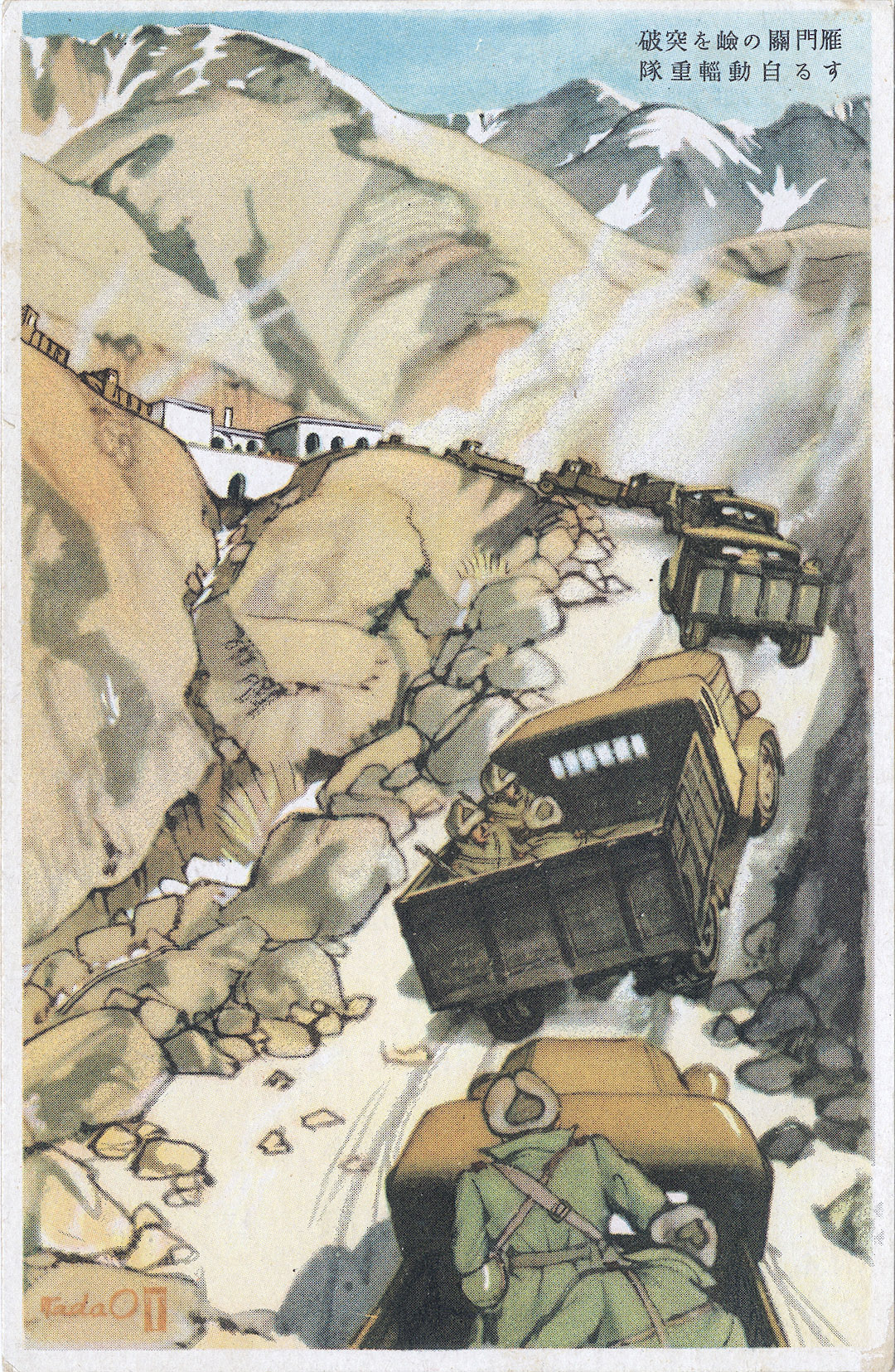
“Breaking through Yanmen Pass – the army moves in broad daylight.” I.J.A. propaganda postcard, Yànménguān (Yanmen) Pass, Shanxi Province, China, 1937, one of the steepest grades along the Great Wall of China and historically considered one of the Wall’s most important passes — a crucial point of defense and a difficult barrier to overcome with its three gates, including the central Yanmen Gate. The Battle of Yanmen Pass was a temporary Imperial Army setback after the start of the 2nd Sino-Japanese War but it shattered the myth of Japanese military invincibility. This counter-propaganda postcard conveyed the Japanese army boldly pressing forward through the barrier despite obstacles. The I.J.A. was successful in capturing the provincial capital at Taiyuan in November, 1937.
See also:
“Assault on Taiyuan Castle”, Taiyuan, Shanxi Province, 1937.
“The Battle of the Railway Corps”, 2nd Sino-Japanese War, c. 1940.
The Battle of Yànménguān, fought in October 1937, was one of the larger early campaigns of the Second Sino-Japanese War. After the Marco Polo Bridge Incident in July 1937, Japan advanced rapidly through northern China. Shanxi Province, strategically important as a gateway to the interior, became a major theater. Yanmen Pass, a narrow mountain stronghold north of the provincial capital, Taiyuan, had long been considered one of the most defensible points in China, and thus became a natural site for resistance.
Chinese forces in the region were led by Yan Xishan’s Shanxi warlord troops, supported by the Eighth Route Army of the Chinese Communist Party under commanders such as Lin Biao and Zhu De. Unlike the more direct open battles around cities, Yanmen Pass saw a heavy reliance on ambushes, guerrilla tactics, and the use of the treacherous mountain terrain to counter Japanese mechanized columns. The Communists, though lightly armed, took advantage of the high cliffs and narrow roads, setting traps, destroying vehicles, and inflicting significant casualties.
One of the most famous actions was the ambush of a Japanese supply column moving through the pass. Chinese fighters triggered rockslides, attacked with grenades and rifles from the ridges, and disrupted the Japanese line of communication. The rugged mountain setting neutralized much of the Japanese advantage in artillery and vehicles. Reports claimed that hundreds of Japanese soldiers were killed or wounded, though the exact numbers vary depending on the source.
The outcome of the battle was a temporary tactical success for the Chinese side. It boosted morale domestically and abroad, becoming a propaganda victory for both the Nationalists and the Communists. Ultimately, however, Japanese forces continued their advance and captured Taiyuan by early November 1937. Yanmen Pass thus illustrates both the resilience of Chinese resistance and the sheer momentum of Japan’s offensive in the opening year of the war.